Monday, October 20, 2008

THE BESPOKE OVERCOAT (1956) won the Oscar for Best Short Subject Film as well as the Venice Film Festival award for Best Short Film. I can see why. The tale is a quiet ghost story based on a tale by Nikolai Gogol (The Vij, Taras Bulba) in which an elderly clerk named Fender, working in a clothing manufacturing company, complains to his boss Mr. Ranting of the cold in the warehouse. Fender asks Ranting whether he can have one of the warm sheepskin overcoats and have the sum weekly deducted from his paycheck. Ranting scoffs that, at Fender's wages, he wouldn't live long enough to pay for the 20 pound overcoat. Fender goes to see his tailor friend Morrie and asks him to mend his tattered old coat. Morrie complains that he can't work miracles with such a shredded coat so he agrees to make a brand new overcoat for Fender at less than cost and have the clerk pay him in installments. Unfortunately, Mr. Ranting soon decides to let the old man go -- after over forty years of service -- with a week's pay. (Sound familiar in these economic times???). The old man is crushed and tearfully tells Morrie to cancel his coat order. Morrie insists he'll still make the coat for him but the cold (and probably a broken heart) kills Fender later that night. At Fender's spare funeral, Morrie tosses the now finished overcoat onto the coffin. The tailor is later visited by the ghost of Fender who insists that Ranting owes him that sheepskin coat after 40 years of service. The new ghost and the tailor drunkenly decide to go break into the warehouse and take it.
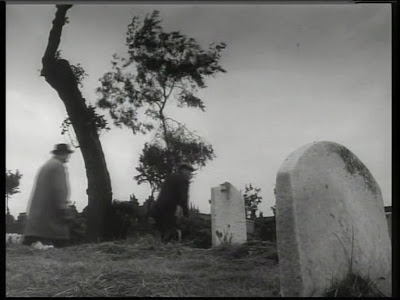
THE BESPOKE OVERCOAT is produced and directed by Jack Clayton who would later bring us the superb ghost film THE INNOCENTS based on Henry James' novella "The Turn of the Screw". You can certainly tell since, in OVERCOAT, Clayton utilizes the same delicate touch and realistic approach to ghostly appearances he would later use in his 1961 classic. Clayton would also direct the 1983 Ray Bradbury film adaptation of SOMETHING WICKED THIS WAY COMES, the hugely popular 1974 film version of THE GREAT GATSBY and the acclaimed 1959 British film ROOM AT THE TOP. There are absolutely no "Boo" moments -- this isn't THAT kind of ghost story. Instead it is an absorbing, realistic, indeed heartbreaking, depiction of the interpersonal relationships and grinding poverty of the two main characters. Comic actor Alfie Bass is almost unrecognizable (except for his voice, of course) as the touching old clerk Fender. Bass is mostly known over here in the States for the 8 episodes of ARE YOU BEING SERVED? in which he played Mr. Goldberg alongside John Inman's Mr. Humphries and Trevor Bannister's Mr. Lucas. Bass is truly remarkable in his understated performance and, in fact, was nominated for a BAFTA award for this very performance. Bass can also be seen through the years in such films as British caper film THE LAVENDER HILL MOB (1951), Roman Polanski's Hammer parody THE FEARLESS VAMPIRE KILLERS (1967), the Beatle's film HELP! (1965), superb British trucking drama HELL DRIVERS (1957) and the swinging 60's Michael Caine film ALFIE (1966).
Good-hearted tailor Morrie is played by David Kossoff and he is equally effective in his role. Kossoff's Morrie is a genuinely warm and caring soul who, even though he himself lives in poverty, still agrees to make an overcoat for the even more destitute Fender. However, Kossoff's performance never comes across as maudlin or saccharine. He is totally believable in his giving nature. Kossoff appeared in many films including the by-all-accounts dreadful 1954 screen version of SVENGALI (also appearing with Alfie Bass), the Cliff Richard teen rock & roll movie SUMMER HOLIDAY (1963), 1960 Hammer Horror THE TWO FACES OF DR. JEKYLL, THE MOUSE THAT ROARED (1959), the early Benny Hill comedy WHO DONE IT? (1956), the also by-all-accounts dreadful remake of NINOTCHKA entitled THE IRON PETTICOAT (1956) starring Katharine Hepburn & Bob Hope and the 1956 film version of 1984.
The only other real part in the film is brusque Mr. Ranting played by Alan Tilvern. Tilvern is also quite good in his relatively minor part but the film is really concerned with the two leads. Ranting doesn't come across as a miserly Scrooge-type villain but instead as a man concerned with the bottom line who finds himself giving the sack to an elderly clerk who has become an annoyance to him. Not malicious but certainly not a caring fellow. Tilvern appeared in the Hammer Horror version of a biopic called RASPUTIN THE MAD MONK starring Christopher Lee, as well as THE FROZEN DEAD, SUPERMAN THE MOVIE and the Ralph Bakshi animated film version of THE LORD OF THE RINGS. The actor also appeared in many TV series including DAD'S ARMY, UFO, DOCTOR WHO, Z CARS and THE SAINT.
Special mention should also be made of the wonderful musical score by maestro Georges Auric which underlines the emotional sincerity of the film. Auric had a long career scoring film music and would go on to score the equally sensitive score for Clayton's THE INNOCENTS. Among the composers other notable screen scores can be found the classic British omnibus ghost film DEAD OF NIGHT (1945), the classic Cocteau version of Beauty and the Beast LA BELLE ET LA BETE (1946), Audrey Hepburn's Oscar winning film ROMAN HOLIDAY (1953), the superb Russian spook tale THE QUEEN OF SPADES (1949) starring the wonderful Anton Walbrook, Clouzot's WAGES OF FEAR (1953), the John Dickson Carr adaptation of THE BURNING COURT (1962), TESTAMENT D'ORPHEE (1960), RIFIFI (1955) and BONJOUR TRISTESSE (1958).

Saturday, October 18, 2008

JOIN US NOW OVER AT OUR SISTER BLOG "BATHED IN THE LIGHT FROM ANDROMEDA" where a new passle of audio has just been unveiled. In keeping with our Halloween-themed month over there, all the songs this week revolve around the pumpkin. So go take a listen, won't you? So click here to be transported to some spooky songs just perfect for October and remember that every Saturday there's something new over at BATHED IN THE LIGHT FROM ANDROMEDA!

Saturday, October 11, 2008

MIDNITE SPOOK SHOWS

MIDNITE SPOOK SHOWS were a unique and spooky fixture across America from the late 1920's to the last gasp in the late 60's-early 70's. They were a strange amalgam of 19th century "magic lantern" shows, the Victorian spiritualist fad, vaudeville, magic shows and midnight horror movie showings. I was just re-reading an eminently appropriate book for Halloween: Mark Walker's celebrated GHOSTMASTERS tome in which he delineates the origins and major practitioners of this sadly defunct fun fest. This was the first real book on the subject I ever came across and it's fairly indispensible to someone, like me, who was too young to ever have experienced this spooky phenomenon. I would heartily recommend picking up a copy for a glimpse at this very under-represented aspect of the horror genre we all love.
What could have been more fun (especially around Halloween or that other favourite midnite spook show day Friday the 13th) than to venture forth late at night to your local movie palace (they were still operating then) to shiver and snicker at a midnite spook show?!? On the whole, every single spook show practitioner was a magician first who decided to take a sideways step into spook shows. Magicians and magic acts have mostly made me yawn but the midnite spook shows spiced things up by including at least one horror movie as well as many horror-themed events. Then, of course, there was the "blackout" as a grand finale: all the lights would be extinguished while glow-in-the-dark phantasms (phosphorescent paint) and ghostly light effects would combine with costumed monsters running into the audience and creepy crawlies climbing all over you. Phantom spider webs would brush up against you or a member of the undead might plant a clammy kiss on your cheek. William Castle would carry on much of this spirit with his gimmick movies that would feature a skeleton cranked out over the audience's heads or wiring a seat with a "Tingler" buzzer. By this time, spook shows were fading fast as the "more sophisticated" audience would find the horror movie the main attraction instead of the ghostmaster's live performance on stage with an incidental horror film thrown in following his show.
Many consider Elwin Peck to be the (for the most part) daddy of midnite spook shows. Taking the name "El Wyn", Peck was a mentalist and magician who, sometime around 1929 got the idea of combining magic with horror elements and a scary movie. El Wyn's Midnite Spook Party was the first wildly successful spook show to play movie theaters always at midnight. Peck's innovation is that instead of emphasizing the magic act he emphasized the ghosts and goblins. Naturally, the theater owners loved it because it allowed them to make money while their theaters would usually be closed for the night. Often the ghostmaster would split the take at the door with the management. El Wyn, unlike most of the spook shows that followed, played the horror movie first and then came out on stage impeccably dressed and make a short speech about the actual ghosts in the theater. He performed many tried and true magic acts: "Spirit Slates" which provided automatic ghost-writing, floating objects and other illusions. To conclude his show, El Wyn would commence with the blackout. As all lights went out, El Wyn ignited a burst of flash powder which would serve to temporarily blind the audience as well as causing the elaborate spooky backdrop to glow in the dark. There were skeletons dancing to macabre music, floating skulls, disembodied faces and ghostly apparitions flying over the audience's heads and flitting down the aisles. El Wyn concluded the fun by firing a pistol as a signal for the lights to come back on. El Wyn was so successful that people would be spilling out into the streets unable to get in. And this was during the Great Depression. Spill over would often require that two separate theaters feature El Wyn's spook show at the same time. Start times would be staggered so that while one theater audience was watching the horror film, El Wyn would be performing live on stage at the other theater. Then, when his act was over he would hotfoot it over to the second theater just as the movie was ending to begin his show all over again. Peck made so much money, in fact, that he retired from spook show performing in the late 30's! But by that time he had many successors.
One of them, Wreford Price, was handpicked by El Wyn to continue on as his secondary spook show headliner. Price took the name of Greystoke the Magician and was taught everything he knew by Peck. Due to the tremendous demand for El Wyn's spook shows, Peck employed Price to handle the demand by performing the same act in venues El Wyn couldn't fit into his schedule. Learning all the secrets from the master, Greystoke went forward with his own midnite spook show with El Wyn's blessing. Price had been a successful magician before he ever heard of "spook shows" but, upon meeting Peck, began performing first under the "El Wyn" moniker in 1930 before taking the name Greystoke and branching out on his own. He also appeared under other names; most noteworthy as "Ali Baba's Spiritualistic Seance and Ghost Show". In this spook show, Greystoke would also employ the illusion of hypnotizing an audience member, stretching him out rigidly across the backs of two chairs, and smashing a rock on the unaware victim's stomach. Later, Greystoke helmed the "Horrors of Hell" show in which he used the name of Dr. Bey Shan and features scantily-clad beauties menaced by torture devices. Price retired from the spook show circuit in 1955 and died in 1973.
Also around 1929, vaudeville mentalist Maurice Kitchen (1896-1962) was introduced to the spook show concept by his press agent George Marquis (himself to become a spook show headliner later on). Kitchen donned a turban and renamed himself Rajah Raboid; headlining his midnight "Spookeasy" show on Broadway in 1930. Raboid began his spook show seated on stage at a dimly lit table conducting seances to communicate with the dead. He also specialized in spirit writing, mind-reading and the "Spirit Cabinet" illusion. Already a traditional way to end a spook show, Rajah Raboid finished with an uproarious blackout in which phosphorescent ghosts were dangled over the heads of the dark-enveloped audience
Arthur Francisco Bull (1885-1964) sort of stumbled into the spook show business. When a theater was looking for a spook show to pile up the profits, it had no candidates and hired Bull for the job -- even though he had absolutely no experience or expertise in that line. Nevertheless, in only a week "Francisco" had cobbled together an effective midnight spook show of his own which would eventually become one of the most elaborate and popular shows of its kind. Francisco's Midnite Spook Frolic often utilized "spirit painting" in which the audience was encouraged to submit the names of dead celebrities and watch dumbfounded as that celebrity's image magically appeared on a blank canvas. His "Gravedigger's Nightmare" was a lengthy routine set in a haunted house in which objects floated, people were decapitated and ghosts and skeletons appeared. Francisco also specialized in placing a volunteer between two plates of glass and firing a bullet right through them. Another great routine was featured late in Francisco's career: Zemora was an unhappy spirit who would not rest in it's coffin. To the accompaniment of spooky music, Zemora would emerge from it's coffin and remove it's own head. The lights would go out and the glowing cranium would float out over the audience.
Also inspired by El Wyn was Allentown, PA's Herman Weber (1900-1953) whose spook show "Midnite Voodoo Party" was inspired by the William Seabrook's 1929 book "The Magic Island" (also the inspiration for Bela Lugosi's film WHITE ZOMBIE). Weber would connect almost every illusion with black magic and Haitian voodoo rites. The show featured Yamadeva ("the skull with a zombie brain") who would answer questions from the audience. Weber would shrink an audience member's head to the beat of voodoo drums and have two people dressed as a witch and a gravedigger change places in full light (known to magicians as "The Farmer and the Witch" illusion). "The Floating Soul" illusion featured the glowing soul of a robed participant (under the spell of voodoo) leave its body and float high over the audience. Weber's blackout finale was especially tailored to scare the pants off the audience; flying ghosts and snakes causes screams to routinely erupt from the audience. Weber became successful enough to write a book about his ghostly illusions called "Out of the Spook Cabinet".
Another very successful spook show maestro was Raymond Corbin or "Ray-Mond" whose various midnite shows had titles ranging from "Ray-Mond's Ghost Show" to "Zombie Jamboree". Ray-Mond jam-packed his show with wall-to-wall strangeness. The show started precisely at midnight with a flash of lightning and a spooky speech. A routine called "Jungle Voodoo" featured a leopard-skin-wearing lovely dancing to voodoo drums on stage. As she finished, a net was dropped on her as lightning flashed again. However, as the net fell the woman vanished to be replaced by a skeleton whose bones cascaded to the floor. Ray-Mond also did levitations and cremations on stage. Ray-Mond's most famous illusion was "The Beauty and the Beast" in which a practically naked woman was terrorized by a gorilla. The woman would faint and be carried away by the gorilla to a table where the gorilla would rip off her arms and legs, hold them high and toss them to the stage with a sickening thud! Audiences were understandably awestruck and screamed bloody murder as Ray-Mond appeared with his trusty gun to despatch the beast.
One of the biggest of all spook show act's was Dr. Silkini's Asylum of Horrors featuring not one but TWO Dr. Silkini's: Jack and Wyman Baker. Jack had been adopted into the Baker family and began his horror act in the late 30's; utilizing his brother Wyman to perform as Dr. Silkini as well in order to double the possible bookings. And they needed it since the demand was so high. Horror and scares were stressed in the show but they were copiously sprinkled with humourous gags. The stage featured a huge Egyptian desert backdrop as several performers dressed as harem girls assisted Silkini's illusions. A change of set dressing would then transport everyone to Dr. Silkini's mad laboratory complete with a monsterous Igor-like henchman to leap out into the audience to chase patrons screaming up the aisle. Silkini's act also featured hypnotism, ghostly seances and a routine in which he would pass a needle attached to a white ribbon through the stomach of a volunteer; the ribbon would come out red the other side! Stooges in the balcony would scream "Oh, I think I'm going to be sick" and faux vomit popcorn boxes filled with corn flakes onto the audience below. One can only imagine the raucous pandemonium amongst the audience members! Silkini's blackout would commence with decapitations and the building of a Frankenstein monster; then as the monster grabbed the bloody severed head and stepped out towards the audience, the lights would go out as the screams began. Fake bats and dancing skeletons would fly out over the audience. While most spook shows would end with the blackout, Silkini continued with his act after the lights came back on with the "Substitution Trunk" illusion featuring a pirate backdop with costumed assistants. One of the most elaborate spook shows of all, Dr. Silkini in fact had a serious competitor in
Bill Neff, a school chum of actor Jimmy Stewart, apprenticed under spook show headliner Punjab, Hindu Miracle Man (actually fellow magician Jack Clifford) who taught him the spook show ropes. Neff's "Madhouse of Mystery" got underway in midnight theater showings during World War II and heavily emphasized the scary and the macabre and was considered the biggest midnite spook show in the land. Neff in fact even toured with Bela Lugosi himself in 1947 as part of his spook show! The stage curtains opened on a mummy case amongst Egyptian-costumed assistants. Neff appeared in a puff of smoke from out of the mummy case, fully tuxedoed with white gloves which, as he tossed them in the air, transformed into two white doves. Neff's specialty was the "Suttee" or "Burning Alive" illusion in which a beautiful woman was hypnotized and laid out on a slab. Her arm would then slip off the side of the slab and hang down. Neff would place her arm back up on top of the slab, fold up the side of the slab to make a coffin, and promptly set it on fire. Then the four sides of the coffin would be collapsed down to reveal a still-flaming skeleton -- whose arm would naturally slip down once again off the side of the slab as the woman's had originally. Another illusion was the traditional "blade box" trick only Neff instilled it with horror elements: it was Dracula's daughter who entered the box (in the skimpiest of costumes, I might add) to have knives plunged into her as a loud heartbeat was heard throughout the theater. In addition to lady vampires, a gorilla would also rush out into the audience and snatch up a patron (obviously planted). After his blackout finale, Neff would wish the audience "Pleasant Nightmares" as the horror film began. Neff's spook show was widely acknowledged as possibly the best in the country. A story goes that a competitor sent stooges to throw tomatoes and eggs during Neff's performance but they were so impressed with the act that they refused and stayed to watch the whole show.
This immense posting has gone on for quite a while and I've only touched on a very few of the past maestros of the art of the midnite spook show. I haven't even gotten to big favourites such as Dr. Zomb, Kara-Kum (sadly rumoured to have been less than exemplary) or Dr. Evil and His Terrors of the Unknown. The GHOSTMASTERS book may or may not still be in print -- I rather suspect that it isn't -- however you should be able to track down a copy and it's well worth doing so. The days when spook shows reigned -- conjuring the ghost of James Dean, calling up the living Mummy on stage, and giving away a free dead body to one lucky audience member (some reports state that this "dead body" given away was actually a frozen chicken) -- are not likely to ever come again and that's a sad commentary on our society's sense of fun and wonder. It does not illustrate some lack of sophistication on the part of past audiences -- they didn't think the monsters were real any more than we would -- but it only points out the woeful lack of fantasy and imagination to which our world has sunk. If we no longer get a thrill and a smile from the thought of spooky scares and monsters, I weep for the future of civilization.
I KNOW IT'S SUPPOSED TO BE SCARY AND CREEPY AROUND HALLOWEEN BUT. . .
Readers of this blog might remember that about 5 minutes after John McCain chose Sarah Palin as his running mate, I posted various reasons why it was a bad choice. Take a look over at the archives on the very day she was chosen (August 29th) if you'd like to refresh your memory. This very choice of running mate also points out the EXTREEEEEEEMELY questionable decision-making abilities of John McCain. I guess blowing up your own side's ship wasn't proof enough of that. Now, Alaska finally catching up with The Land of Cerpts and Honey, has found through a bipartisan investigative panel that Sarah Palin unlawfully abused her power in violation of the ethics laws. You remember, don't you, that one of only two things the extremely short-term governor is known for was her so-called "championing of ethics in government". Now, I know I really didn't need somebody else to tell me what a terrible choice Palin was but it's certainly nice to have an independent, bipartisan committee agree with me -- even if it IS about a month and a half later. Frankly, Palin's entire career shows that she is against everything . . . unless it could benefit her. She's obviously for ethics in government . . . unless she can use her office to fire the guy who's divorcing her sister. The very definition of the statute which Palin has now been found guilty of violating is "any effort to benefit a personal or financial interest through official action is a violation of that (public) trust." You'll also notice there need be no "financial" interest but also any "personal" interest -- that is, maliciously trying to fire a state trooper who is divorcing her sister and then actually firing the boss who refused to fire him.
Would this finally be the point where the Republican Party stands up and apologizes to the country for putting up such a pair of bozos who are not what they sold themselves to be. After all, by constantly chirping in their own political ads the patently ridiculous claim that McCain and Palin are "mavericks" who will bring "change", they are actually spitting in the face of the Republican Party itself (who has been in power for the last 8 years and almost as long in Congress). McCain has never been liked or trusted to be a "true Republican" by Republicans (which is presumably why they dragged Palin onto the ticket as a "true conservative"). McCain and Palin themselves disagree on most things; although it's tough to find out where McCain truly stands since his stance on every political issue changes depending on whether he's running for office or not that year or, in fact, on what portions of his own personal history can he make up whole cloth or factually alter by cutting and pasting the text of his speeches from Wikipedia! This all goes back to my theory that the Republicans, by choosing McCain in the first place, don't WANT to win this November. The state of the country is in such a mess that I've thought for the past year that they'd rather a Democrat wins who, no matter HOW good, will not be able to fix everything in four years. Then the Republicans can say "See that?!? The Democrats didn't fix anything. Now vote for us!" in four years. Can you think of any other explanation why the Republican Party would have these two candidates running???? Myself, not believing Republicans are stupid, can't think of any other explanation.
It's getting a little late. . .it would've been nice if they had done it before now. . .but it could only make the Republican Party look good if they simply stood up for the party which they are supposed to believe in and say, "You know, America. We're sorry but these two aren't who we thought they were and we can't in good conscience keep them on our ticket. Here's another Presidential and Vice Presidential candidate we hope you'll like better because these two are fit for nothing but the scrap heap." Wouldn't that be nice? And, in fact, ethical.

Friday, October 10, 2008

Um, yeah. That really is Cheeks and me back in 1911 carving a pumpkin in the Rustler Steak House parking lot.
You'll notice I am properly and respectfully attired in a hat while Cheeks has concealed under his pants the fabled race-car shorts mentioned in a speech by Ronald Reagan.
And by the way, the new audio postings on our sister blog BATHED IN THE LIGHT FROM ANDROMEDA is up a day early. The Halloween theme this week is spooky songs by singers one doesn't associate with spooky songs. Give it a listen and we'll see you back here.

Tuesday, October 07, 2008

THE VERY MINOR VINCENT PRICE FILM "DIARY OF A MADMAN" (1963) was brought to you by the very same company who brought you Vincent Price's TOWER OF LONDON. But not the classic Universal TOWER OF LONDON starring Basil Rathbone, Boris Karloff and a young Vincent Price locked in a tot of Malmsey. This is the 1962 TOWER OF LONDON brought to you by Roger Corman and his brother Gene. The company was called Admiral Pictures and, if you've ever seen 62's TOWER OF LONDON you probably know what to expect of DIARY OF A MADMAN. And that is not much. While TOWER was uninspiringly directed with boredom by Roger Corman, DIARY is just as blandly directed by Reginald LeBorg (responsible for those late 50's shoestring productions VOODOO ISLAND and THE BLACK SLEEP as well as several entries in Universal's Lon Chaney Jr. INNER SANCTUM MYSTERIES series and THE MUMMY'S GHOST also with Chaney). DIARY OF A MADMAN is about on par with those 50's flicks and not as much fun as the earlier Universal's (which themselves were second tier). DIARY OF A MADMAN is, of course, meant to mimic the AIP Poe pictures Price made with Corman but it's the palest of imitations. While the sets are cheap but workable, the film is entirely overlit. Instead of resembling the moodily-lit, atmospheric Poe films at AIP, DIARY instead looks much like the similarly AIP-apeing TWICE TOLD TALES. But be warned -- I'll tell you this up front -- by the end of this review I will have BUSTED WIDE OPEN an unknown fact about this film which ALL reference sites have gotten wrong wrong WRONG! Wait for it! But, until then...
Basically, the film is based on the Guy de Maupassant story of "THE HORLA" but there is really only one reason to watch it. And you know what that is. Yes, Vincent Price. Always interesting and always capable of drawing the eye, Price here is the "subdued" version and not the over-the-top PIT AND THE PENDULUM Vincent. Even so, he captures your interest the moment he walks on the screen; and his absence is even more acutely felt when he's not up there. Because that leaves us with the blandest collection of supporting players you'd ever want to ignore. All, that is, except the rather interesting Nancy Kovack who acquits herself rather well with Price and actually manages to be quite watchable. Not just a pretty face, Flint Michigan's favourite daughter (OK I'm making that up) can also be seen as Medea in the Ray Harryhausen classic JASON AND THE ARGONAUTS as well as the first Dean Martin Matt Helm movie THE SILENCERS. Kovack was also a familiar face in many 60's TV shows from BATMAN and BEWITCHED to THE MAN FROM U.N.C.L.E. and STAR TREK (the episode "A Private Little War" featuring those pesky Klingons klinging all over the place). Kovack here plays a rather grasping gold-digger but manages to instill her character with a likeability rarely evident in such a character. The little twinkle in her eye also shows what a perfect casting choice she was to appear next to Vincent Price; she has been quoted as thinking very highly of Price (who didn't?) and tells that the well-known actor was very respectful of this relative unknown actress. They also got along famously. Kovack reveals that right before shooting the scene where Vincent is supposed to murder her, he playfully tickled her with the knife and reduced everyone to giggles.
Back to Maupassant. "THE HORLA" (DIARY'S original working title) is an invisible evil entity which can take over people and cause them to moider! Magistrate Vincent Price visits a condemned murderer and, when the formerly mild-mannered fellow tries to kill him, Vinnie accidentally kills the moiderer. Of course, the Horla had possessed the crook and, now dead, it needs ANOTHER host -- and that would be Vincent. First the Horla causes Vincent to moider his pet canary Kiki (thank GOD!) and then he moves up to people. Vincent's 12-years-dead wife killed herself because he blamed her for the death of their son. A former sculptor, Vincent comes across artist's model Nancy Kovack and asks her to pose for him as he restarts his sculpting. Kovack unfortunately is a money-grubbing ho (but charming) and she's already married to a poor starving artist (almost invisible himself Chris Warfield. However, smelling money Nancy leaves the starving artist after Vincent proposes marriage to her. Who can blames her with a drip like Chris Warfield. Maybe THAT'S why we are somewhat sympathetic to her character?!? Anyway, Warfield confronts Price with a patented "That's My Wife!" speech and the Horla compels Price to knife Kovacks to death and place her decapitated head inside the clay bust he had sculpted of her. The one and only stylish (or memorable) scene in the film is when the amnesiac Price follows a trail of blood droplets to scrape away the clay from the sculpture revealing the dead woman's staring eye.
Naturally, Kovack's artist husband is arrested for her murder and Price wages a battle of wills against the Horla's mental control.
Things go on pretty much as you'd expect -- right down to the traditional "Vincent Price-in-an-AIP-Poe-picture" final fiery conflagration. Any special effects, such as they are, amount to the usual cheap "invisible being moving objects around the room" variety. But at least the wires don't really show. In fact, that's somewhat of a miracle in such an obviously low-budgeted film. There is also a green light superimposed over the eyes of anyone (usually Vincent) possessed by the Horla. Think Lugosi in technicolor.
And as for my controversial new information about the film??? Well, long-time voice actor Nelson Olmsted is credited in every reference work I've ever seen about this film as Dr. Borman while still-working actor Joseph Ruskin (his most recent appearance was on the TV show BONES) is credited as the voice of the Horla. This is absolutely incorrect. Ruskin, as far as I can tell, is not known for voice work -- in fact, he is the ONLY actor to appear on screen in four separate STAR TREK series as well as the movies (Majel Barrett did voice work only on some of 'em, remember). However, Nelson Olmsted is known primarily as a voice actor -- much in the mold of Paul Frees -- and the voice of the Horla in this movie is unmistakably Olmsted's. I known Olmsted's voice very well. I've had his LP record TALES OF TERROR (in which he reads various scary stories by Poe, Bierce, Stevenson etc.) since I was a little kiddie-winky. And it seems rather obvious to me that, since the Horla is a vocal performance only, Nelson Olmsted would be the man to do it. And, like I say, that's Olmsted's voice whenever the Horla speaks. No mistake about it. So, you heard it hear foist. All the reference books (and imdb) are wrong. And now that I've cleared up this burning question, you may go back to your regularly scheduled October.

Tuesday, September 30, 2008

THE BEETLE: A MYSTERY BY RICHARD MARSH was published in 1897; the same year as Bram Stoker's DRACULA. In fact, the two authors knew each other and there's a rather apocryphal story that both men had a wager as to which of them could write the more successful horror novel. Almost certainly this never happened; but in actuality THE BEETLE outsold DRACULA for a time. It is a tale of gothic horror featuring one of the most bizarre monsters ever seen. Richard Marsh (the grandfather of horror author Robert Aickman) imbues the book with creeping horror as well as a Victorian love triangle, the then-current rage of Mesmerism and echoes of Sherlock Holmes. Like DRACULA, THE BEETLE is also told from several points of view; it would probably suit Quentin Tarantino for his next film project.
The novel begins with the story of Robert Holt: a man so down on his luck that he's turned away from the poorhouse! You can't fall much farther than that, can you? Well, Holt comes across a backstreet with a house that looks to be empty. He climbs in the window to get out of the weather and promptly encounters a strange creature who mesmerizes him with his eyes. The creature alternately appears to be a strange-looking man lying in a bed as well as a shape-changing grotesque giant beetle who forces Holt to it's will. A scene where the lights go out and Holt can feel the spider-like legs of the Beetle crawling slowly up his leg is genuinely creepy. Possessing some grudge against crusading politician Paul Lessingham, the Beetle sends a naked Robert Holt out into the night to burglarize him and utter two threatening words to the famous man: "The Beetle!" The effect of those two words on the normally stoic gentleman reduces him into cringing putty --not once but several times during the course of the novel. After keeping the naked Holt dirty and starving, the Beetle eventually sees fit to have him collapse in the street seemingly dead. The wretch is taken indoors by Marjorie Lindon; who just happens to be Lessingham's fiancee.
This is only the beginning of the story. After Holt's tale is told, we next have an entire section told by a Sydney Atherton which interweaves into the Holt and Lessingham events. It seems that Atherton grew up with Marjorie Lindon and, while she considers him like a brother, he wants to marry her. Unfortunately for him, she loves Lessingham (this is where the Victorian romantic triangle comes in). Atherton has his own encounters with both the Beetle and Holt and, after his section of the book another section commences retelling the events from Marjorie Lindon's point of view. Like a Victorian -era VANTAGE POINT, the overall story is slowly revealed and crystallized through several different viewpoints. Whereas this device used in Stoker's DRACULA has never ceased to annoy me, here Marsh's use of it is actually very readable. My only problem with Marsh's writing, in fact, only occurs now and then with his slightly annoying use of overly deliberate argumentative dialogue. A minor quibble but it can grate on one's nerves after a while. Other than that, the novel is what I would definitely call a "page turner" and I seemed to rocket right through it.
My copy of the novel is, of course, from the wonderful (and highly affordable) Wordsworth Edition paperback. I should probably mention one rather startling passage which came as a complete surprise to me. In a paragraph I never expected to read in an 1897 novel, the heroine writes: "One result the experience had on me -- it wound me up. It had on me the revivifying effect of a cold douche." Yeah, I had to read it about 3 times to make sure I had read it right, too! And I can definitely say I never heard Mina Harker utter a similar phrase; no matter HOW much of the "new woman" SHE was supposed to be! Another aspect of the Beetle which makes the monster particularly bizarre is that is shapeshifts between male and female sexes quite routinely; giving an extra-added oddity to the monster. And unlike Stoker's DRACULA (which couched all sexuality in metaphor), Marsh's BEETLE features quite a lot of naked flesh: the aforementioned Holt running around unclothed for much of the novel as well as the nude female body displayed by the Beetle itself! Whereas the sexual "naughtiness" in Stoker's novel is subconsciously Freudian, Marsh's novel puts it right out there up front. For solid Victorian creepy fun, THE BEETLE by Richard Marsh fills the bill admirably.

Saturday, September 27, 2008

VERY VERY VERY SAD TO HEAR OF PAUL NEWMAN'S DEATH AT AGE 83. One of the last true titans of the silver screen. His impressive film career goes without saying but here are a few of the movies and performances of which I am particularly fond:
  • The Long Hot Summer (1958)
  • The Left Handed Gun (1958)
  • Cat on a Hot Tin Roof (1958)
  • The Hustler (1961)
  • Hud (1963)
  • What A Way To Go! (1964)
  • Torn Curtain (1966)
  • The Towering Inferno (1974)
  • Slap Shot (1977)
  • The Verdict (1982)
  • Nobody's Fool (1994)
  • Message in a Bottle (1999)

Friday, September 26, 2008

A VERY HAPPY 90th BIRTHDAY TO ZACHERLEY! The original horror host! The Cool Ghoul himself! Of course, words fail when it comes to telling how much the guy means to me. Way back in 1958, John Zacherle was asked to host a late night horror movie show called Shock Theater: the newly-released to television classic Universal horror film package. Zacherle took the name of Roland (pronounced Row-LAND) and debuted on late night Philadelphia TV station WCAU-10. My mother was teenager at the time and later regaled me with tales of watching his show. She would stay up late to catch whatever insanity Roland was hurling at the TV screen; including breaking into the movie and inserting himself into the action at appropriate moments to liven things up. Roland, however, got so popular that he was snatched away to New York City and took the name of Zacherley. The Cool Ghoul also released several successful record albums (including his smash hit DINNER WITH DRAC) and even ran for President! The usual stupidity of TV station managers eventually saw the cancellation of just about every horror host in the land. But ever since, the Cool Ghoul has been making appearances all over the place and he is still the top of the horror hosts. I had the pleasure of meeting him a few years ago and he's just as hysterically funny in person. Once again, I'd like to wish John Zacherle the happiest of Happy Birthdays!
Monday, September 22, 2008

JUST A NOTE OF SAD RESIGNATION. As I'm sure you know, the Halloween season is almost upon us. My favourite time of year when the skittering of fallen leaves gently scrapes down neighbourhood streets and the autumn moon holds sway. The gingersnap cookies have appeared on store shelves and hot cocoa suddenly looks like a great idea right about now. As many of you may or may not ALSO know, I will shortly be "at liberty" as far as gainful employment is concerned. Hopefully this condition will not persist for very long but either way I very much doubt I will have the opportunity to encore my month-long Halloween Countdown which many of you enjoyed last year. If you missed it, last year's Halloween Countdown featured a post EVERY DAY of October -- actually TWO posts every day: one post on something "Halloweeny" and another post for the daily "Halloweeny" movie. That's right, each day I chose one Halloween-type horror film to watch and review.
My giving the Halloween Countdown a miss this year arises not from any lack of desire on my part but simply because most of my blogging for the last two years + has been done right here at work where I have much more access to the internet. This also means that my postings on this blog might become a little less frequent than we're all used to. I'd still love to get online every day but, with things up in the air at this time, I just can't predict what success I'll have doing so. And as we all know, unless the Halloween Countdown is done every single day there really isn't a point to it.
So, having said that, I would encourage you to look over there on the right for last October's archives and you can re-experience the daily Halloween countdown. Hopefully, if you're as forgetful as I am, it'll all seem brand new to you anyway! Also I would urge you to go visit John Rozum's blog which, as usual, will be doing his own Halloween countdown; there you will also find on the first of October a listing of links to similar blogs doing their own Halloween Countdowns. But rest assured, while I may not be blogging every single day I will still be posting as frequently as I can. And yes, I'm not going to let Halloween go by in this blog without celebrating it. So chins up, me hearties. THE LAND OF CERPTS AND HONEY (as well as our sister weekly audio blog "BATHED IN THE LIGHT FROM ANDROMEDA") will still go on strong. And. . .just between you and me. . .there might even be a third blog coming along somewhere on the horizon. If I can swing it. More on that later. But for now, thanks for reading.
MAN, I REALLY HATE 13 GHOSTS. Not the Dark Castle remake of a few years ago which I very much enjoy. I'm talking about the original 1960 William Castle film 13 GHOSTS. Whereas Castle's earlier HOUSE ON HAUNTED HILL with Vincent Price I could (and do) watch over and over again, 13 GHOSTS is just painful to watch. Readers of this blog probably know that I don't usually like ripping movies apart; I always try to find the enjoyable aspects of every film. And, for the most part, any movie I'm going to talk about usually has SOME redeeming qualities or else why take up your time and mine discussing it at all. I'm no critic who gets his jollies ripping apart someone else's project; usually a project which many creators sweat blood in order to bring to fruition. But when it's bad, it's bad, folks! And as someone who holds the horror genre very dear, I cannot find much good to say about the squandered opportunity that is 13 GHOSTS. For some reason, Castle decided to instill the film with all the scares and atmosphere of a child's pantomime show of Puss 'N' Boots. There isn't a scary moment in the film, granted, but there also isn't an atmospheric or even mildly spooky moment either. There is no hokey but nevertheless very effective scare like the one when hag-like Leona Anderson, grimacing with white contact lenses, pops out of the dark to scare the willies outta the ingenue in HOUSE ON HAUNTED HILL. And that's really a shame because 13 GHOSTS could've been just as much fun as HOUSE ON HAUNTED HILL. Especially since the ghosts in THIS movie are apparently real; as opposed to the earlier film.
And speaking of those ghosts, they are even a pathetic, unfrightening lot. The ghost of a lion?!?!? Give me a break. A milk bottle floating across the kitchen with less technical prowess than an episode of BEWITCHED?!?! It almost seems like William Castle had a strange contempt for his audience which he never displayed in his other hokum. Never a great filmmaker, Castle nevertheless usually entertained; but here 13 GHOSTS has the slipshod feel of a movie which had to be made to fulfill contractual obligations. Although I don't think it was. All Castle's films also featured a gimmick (a la the paper skeleton flying out over the audience or theatre seats wired with buzzers) and here Castle provides the audience with special glasses which allow you to see the invisible ghosts on the screen. However, the movie is so uninteresting and the ghosts so unimpressive, one wonders why the audience would bother wanting to get a look at the apparitions. The movie's direction is simply a fatal flaw.
Another fatal flaw is the casting. Bland would be the word. Firstly I'd like to single out young Charles Herbert (who also appeared in THE FLY with Vincent Price) as the most likeable and interesting actor in the entire cast. And those of you who know my usual low opinion of child actors should find this statement extremely unusual -- and extremely telling in regards to the rest of the cast. The wonderful Margaret Hamilton (you know. . .the Wicked Witch of the West) is good, of course, in her Martha Mattox-like spooky housekeeper role but she is given very little to do. Rosemary DeCamp is likeable enough and capable in her role but I would say she is miscast. Martin Milner as the "nice boy lawyer who seems too nice" would've been fine casting if Milner hadn't telegraphed his character's ulterior motives so obviously. One suspects the director here of telling Milner to be less subtle because the actor plays it as delicately as a frying pan to the frontal lobe. And I've saved the worst for last. Donald Woods is simply unbearable to watch as the sappy father who inherits the spooky old mansion (which isn't spooky in the least -- the overlit set in fact looks like Ozzie Nelson should live there with brightly-painted walls and nary a cobweb to be seen). But back to Donald Woods; he was never much of an actor to begin with and he nearly torpedoed the otherwise quite good episode of BORIS KARLOFF'S THRILLER entitled "Yours Truly, Jack the Ripper". But here, he manages to sink 13 GHOSTS! The actor would be more at home on MR. ROGERS' NEIGHBORHOOD than here. Woods seems puzzled throughout the film; not because of the goings on inside the haunted house but because he has no idea how to play his part or even, probably, why he was cast in the film. We the audience wonder why as well. Woods strikes me as a more insipid version of Hugh Marlowe; who himself was always only Richard Carlson-lite! Woefully miscast, Woods frequently -- and I do mean frequently -- stares face to face with a supposedly-threatening ghost and registers no fright whatsoever. For such a milquetoast actor, you'd at least think he would show mild concern for his (and, more to the point, his FAMILY'S) safety. But Woods shows all the emotion of a man trying to get an egg stain out of his necktie. In fact, the entire cast (except for the otherwise forgettable daughter) never shows the slightest inkling of fear at these ghosts. Most normal folks would be running around peeling garlic and carving crosses by this point. Even little Haley Joel Osment had the good sense to load his bedroom tent with religious statuary!!! Woods stands around obviously thinking "What should I do now, Mr. Castle?". DeCamp shows annoyance at the homicidal ghosts as if they were a dog that tracked muddy pawprints across her nice kitchen floor. As a matter of fact, the entire movie plays more like a floor wax commercial than a horror movie. Very sad. And what a waste. 13 GHOSTS had the potential to be a fun, hokey ghost film in the vein of HOUSE ON HAUNTED HILL. What the hell happened?!?!?!

Saturday, September 20, 2008

"THERE ARE MORE THINGS IN PHILOSOPHY THAN ARE DREAMT OF IN HEAVEN AND EARTH." "WHISTLE AND I'LL COME TO YOU" was a short film made in 1968 by director Jonathan Miller for the TV series OMNIBUS. Thanks to the kind generosity of Weaverman over at FLEAPIT I now have the film to peruse. (READ HIS OWN REVIEW OF THE FILM BY CLICKING HERE). The film is based on one of the classic ghost tales of M.R. James and it's one hell of an oddball film; not what one might expect. Weaverman professes to have had the bejabbers scared out of him the first time he saw it but also feels a kind of letdown in it as well on subsequent viewings. I've only watched it once (but I shall soon watch it again); however I can honestly say I wasn't disappointed at all. In fact, I thought the film to be rather astonishing and ballsy in its determination NOT to be sensationalistic but instead to follow the quiet, almost methodical spinning out of the ghost tale in exactly the same structure as many ghostly short stories on the printed page.
The two main areas where a viewer might have trouble will probably be at the beginning and the end. The film starts and goes on for quite some time without seemingly bothering itself about a plot. However, the plot is there and being subtly introduced -- I suspect a second viewing would make this even more clear. As for the end, it may seem by some to be kind of abrupt -- the major "ghostly happening" occurs and the film ends almost immediately. However, this is much the same structure that most classic ghost stories (and other horror short stories) follow; the story ends right as the major supernatural event has just occurred. In fact, a great many H.P. Lovecraft stories end right BEFORE the horror reveals itself.
The beginning of the film (after a short voiceover narration by Miller describing author M.R. James) finds our lead character Professor Parkins (a truly astounding performance by Sir Michael Hordern) arriving for a holiday in a rather desolate-looking, windswept and gray East Anglia (the B&W grainy photography of the film is a definite plus - it always looks distinctly chilly and windy throughout the film). The Professor is a dusty academic who seems desperately lonely on the one hand while also being utterly incapable of any normal social interaction with his fellow human beings. I simply can't think of another occasion when Hordern has been so completely watchable as he constantly mutters to himself, carrying on interior dialogue with himself, while absent-mindedly picking up stray words from the people who surround him without really comprehending what they're saying to him or what his proper response should be. Miller points out the Professor's loneliness by having him stay in a hotel room with two beds; underlining the fact that Parkins is by himself. The Professor in fact would much rather consult with his books or walk off along the dunes by himself than interact with other people; not because he wishes to be alone so much as that he doesn't know how to interact with other people. Hordern's performance is really remarkable in that he does not fall into the trap of making the Professor a dry academic caricature but instead breathes life into this eccentric antiquarian. A particularly sparkling moment occurs when Hordern grumbles to himself that he TOLD them he doesn't like tomatoes as he distastefully picks them out of his plate. Priceless acting all the way!
After seeing (at length) two chambermaids making up the beds in what will be the Professor's room, Parkins arrives at the hotel only to be greeted -- no, that's not the right word -- faced with a hotel manager who seems even less capable of social interaction than Parkins. The fellow mumbles so quietly and incoherently that one only catches about every 7th word. He's even more awkward around people than the Professor! This is just our first hint that odd things will occur during Parkins' stay. The scene where the man halfheartedly attempts to show the Professor his room is hilarious in its awkwardness; the hotel man obviously doesn't want to have to do it but somehow feels he must while the Professor wishes for nothing more than for the man to get the hell out and fidgets helplessly as the man interminably fusses and mutters. This scene is followed by an equally funny and awkward scene as Parkins goes down to the dining room for dinner only to find everyone has started without him. He takes his seat markedly separate from the other diners and sits there muttering to himself, obviously anxious to eat but worrying that the servants will never actually bring him any food since he's been late to table. While these scenes might seem to do nothing towards the furtherance of the plot, they indelibly map out Parkins' character which is so essential to what is about to happen to him. The Professor's intense discomfort around other people is conveyed beautifully as he stands in the hallway as another couple pass by. Hordern literally contorts and stretches his body AWAY from the people passing behind him until he's literally standing on the balls of his feet and leaning away from them -- almost resting his head on the wall in front of him. Now that's social anxiety, folks! It is precisely the characters inward-turned solitude that positions him for the ghostly happenings to come and why he is particularly susceptible to them.
This also, I think, shows how really gutsy Jonathan Miller was to keep the pace of the film slow and steady. Nothing is rushed but all unfolds in its own time. This lends a valuable quality to the feel and mood of the film so that the ghostly occurrences are actually startling. In fact, on one of the Professor perambles along the beach we almost don't notice at first the shadowed figure far behind him on the horizon -- until Hordern turns around himself and notices him. Whether this is meant to be the first appearance of the ghost or not isn't spelled out. However, the shot is held on the distant figure even after Hordern exits the frame. It is, in fact, just after Parkins discovers a wooden whistle in the partially eroded grave close to the beach that this figure first appears. I'd say it ain't just some old age pensioner going for a paddle, wouldn't you?!? When Parkins gets the whistle cleaned up he notices words in Latin carved on it. Translated it reads: "Who is this who is coming?" The Professor blows the whistle rather brazenly to find out. After he has blown the whistle, there has obviously been some change in him: his face registers puzzled apprehension. The scene immediately dissolved to that scene back at the beach with the distant figure -- but somehow the figure appears to be closer now. For the next several nights, Parkins has trouble sleeping. He spends much of his time sitting up in bed listening intently and, when he does sleep, is awakened by nightmares of being chased by an unseen figure. We hear marvelously unsettling sounds on the film's soundtrack at this point. Then, during a particularly vivid nightmare which visually reminded me greatly of Carl Dreyer's VAMPYR, we see the ghostly apparition and I can honestly say it's truly creepy and unsettling; it is literally a sheet (the most caricatured caricature of a ghost) bizarrely levitating in slow motion. Truly horrific when you see it! Once again, the marvelously cold B&W grainy photography and slow motion effects make the apparition indistinct and fluttery so you're not exactly sure what you're seeing. All you know is it look VERY unnatural and unsettling. The next day Parkins learns that the bed linen on his room's spare bed looks slept in -- SOMETHING has been in it. Obviously with the constant rustling noises, nightmares and overturned bedclothes, SOMETHING is indeed coming. Jonathan Miller's direction and Michael Hordern's acting vividly convey that sense that "something" is in the room with you, "something" is following me, "something" is just there in the corner of your eye, just beyond perception and only offering a fleeting glimpse. When it finally does arrive, the Professor is almost reduced to infancy momentarily from his mind-numbing fear.
WHISTLE AND I'LL COME TO YOU is another of those films which requires an attention span. In fact, that's probably the boldest thing about it -- even in 1968! It is positively daring in its subtlety. In that way, it greatly approximates the feel of an actual M.R. James short story; none of which are known for their pyrotechnics. WHISTLE is in fact one of those perfect "chill October night" viewings when the wind is blowing bare branches against your window pane. There's a chill running throughout the film and I like it. After all, isn't that what a good ghost story is supposed to give you? WHISTLE AND I'LL COME TO YOU isn't the best ghost movie by any means but it is daringly audacious and I think very successful in what it set out to do: offer up the genuine chill of a ghostly tale for all those who care to follow where it takes them. And I, for one, will never forget the appearance of that horrible, unnatural "thing" behind Michael Hordern in his nightmare on the beach!!!