 Recently I had a little discussion about what could be my favourite film. I was naturally unable to choose just one film among the thousands I love. How can you pick just one film to be your favourite when movies differ so widely from each other? Western, musical, horror film, comedy. So I decided it was about time to winnow down all the movies I love into a list of a select hundred. The choosing of the films to make the list is, naturally, totally subjective. Ask me at any given time to pick 100 and I'm sure the list with be different each time. However, after much thought and agonizing eliminations, I've come up with the 100 I would now call my favourite. I might add that these are not representing what I think are the BEST movies ever made; this list of 100 only represents my subjective favourites and therefore will feature some films which are not exactly shining examples of the cinematic art -- but merely those 100 films which I connect with most strongly. Now, I still don't have a number one fave and this list is not going to be in order of preference. I've decided to form the list chronologically starting with the earliest. As to prevent the list from becoming too unwieldy, I have also decided to post the lucky hundred in groups of ten at a time. So here we have the first ten (and earliest chronologically).
- M (1931) dir. Fritz Lang -- German film based on a true story of a child murderer, the monumental performance of Peter Lorre deservedly catapulted him to world stardom. Lang's surehanded direction is masterful in ratcheting up the suspense while making the homicidal maniac partially sympathetic as well as reprehensible. Grieg's music of "In The Hall of the Mountain King" would never be heard the same way again. Lorre is simply stunning!
- Frankenstein (1931) dir. James Whale -- While many critics prefer the sequel (you will however notice BRIDE OF FRANKENSTEIN does not appear anywhere in my top 100 films) this is the one that captures my imagination. Here Whale plays it straight (you should pardon the pun) and creates a gothic Universal horror for the ages. Obviously this is the movie that made Boris Karloff a star; aided by the masterful makeup by Jack Pierce. From the opening shots of Colin Clive shoveling dirt in the face of a statue of Death himself to the final conflagration at the windmill, this film is an almost perfect poem of morbidity and death which towers above almost all others.


- Trouble In Paradise (1932) dir. Ernst Lubitsch -- Undoubtedly the director's finest film, this sparkling glass of champagne is the ultimate expression of pre-code Hollywood in its frank depiction of sex and seduction. . .not to mention petty larceny. Herbert Marshall has never been better as the suave jewel thief who falls for and teams up with fellow jewel thief Miriam Hopkins. However, when Marshall goes after the wavishing Kay Francis, he's torn between his larcenous ways and his heartstrings. One of the most sophisticated comedies ever made; it's quite European in feel even though it was made in America. The height of 30's art deco aspirations.
- The Mummy (1932) dir. Karl Freund -- Gifted cinematographer Freund takes to the director's chair with this waking nightmare that plays like a projected dreamstate up on the screen. Basically a retelling of Universal's previous hit "DRACULA", this tops it by leaps and bounds. Karloff again appears in breathtaking Jack Pierce makeup as the revivified mummy Imhotep as well as the parchment-faced Ardath Bey; trying to stop the European infidels from robbing the tombs of Egypt. Exotic Zita Johann is perfectly cast as the reincarnated Egyptian princess and many of the cast from "DRACULA" appear as well. Seldom has the feel of a dream been so beautifully realized up on the silver screen.
- The Big Broadcast (1932) dir. Frank Tuttle -- Another pre-code film which has fun with the concept of Bing Crosby committing suicide, this utterly bizarre and surreal musical has to be seen to be believed. Most of the biggest radio stars of the day (Kate Smith, The Mills Brothers, The Boswell Sisters, Cab Calloway and Der Bingle himself) cavort in almost a stream of consciousness movie involving a radio station's bid for success by putting on the biggest broadcast ever. The aforementioned "suicide attempt" scene involves Stuart Irwin and Bing, both jilted by women, turning on the gas to kill themselves. They then hallucinate the ghostly form of Arthur Tracy (The Masked Tenor of the Air) slithering through a grate as vapour singing the incredibly unsettling "Here Lies Love". There's never been a musical like it before or since.
- The Old Dark House (1932) dir. James Whale -- Back to the mischievous James Whale with his archest of black comedies involving a small group of people (Melvyn Douglas, Raymond Massey, Gloria Stuart, Charles Laughton) seeking refuge from a storm in a . . . well, old dark house. . .belonging to the wildly eccentric Femm family (outrageously camp Ernest Thesiger, dour Eva Moore and their mute brute of a manservant Boris Karloff). Amid the lightning and thunder, there is talk of another Femm locked away in the attic due to his penchant for pyromania. Add to this mix the ancient patriarch of the family (played by the female Elspeth Dudgeon with wispy white beard) and you have the maddest of madhouses. Gloria Stuart, dressed in a slinky white satin dress, was instructed by Whale to run through the darkened corridors as if she was a flame moving through the eerie house. "Have a potato!"
- Duck Soup (1933) dir. Leo McCarey -- The Marx Brothers' masterpiece of insanity. Unlike all the other Marx Brothers movies which are saddled with incredibly insipid love stories involving bland engenues, here the Four Marx Brothers are let loose for total insanity. The nation of Freedonia is going to war. And I can see Margaret Dumont is bending over a hot stove. But I can't see the stove!
- Holiday (1938) dir. George Cukor -- Cary Grant is a working stiff who falls in love while on vacation. What he doesn't know is that the girl he's fallen for is stinking rich. Her sister Katharine Hepburn is the black sheep of the family and brother Lew Ayres has taken to drink to cope with the heavy burden of corporate responsibility rich Papa has placed on his shoulders. Naturally we're rooting for Cary and Kate to get together instead. Sister Doris Nolan is all wrong for him. Edward Everett Horton and Jean Dixon are Cary's hilarious down-to-earth friends the Potters. Binnie Barnes and Henry Daniell are the rich and snooty relatives. And Kate's playroom (where meetings are held for the Anti-Stuffed-Shirt and Trapeze Club) is the ultimate sanctuary of my dreams!
- Stagecoach (1939) dir. John Ford -- A masterpiece which saw John Ford learn how to make a "grown-up" western and found John Wayne catapulted to stardom as The Ringo Kid. A disparate group of people (Claire Trevor, Thomas Mitchell, John Carradine, etc.) board a cross-country stagecoach while Geronimo is on the warpath. The interrelationships between the characters is a marvel to see and the typical awe-inspiring John Ford shots make this one of the greatest westerns ever made.
- Mr. Smith Goes to Washington (1939) dir. Frank Capra -- A senator drops dead and the political machine who owned him decides to place a young, naive boys club leader in the senate as their compliant puppet. Unfortunately for them, Jimmy Stewart can't be played like that. Jean Arthur is magical as the jaded secretary who is charged with nursemaiding the new senator. Claude Rains as Stewart's mentor is also quite fine as the senior senator also in the pocket of political boss Edward Arnold. The climactic fillibuster with a hoarse Stewart refusing to yield the floor of the Senate until a smear campaign against him is proven to be all lies is thrilling, inspiring and yes a little dose of "Capra Corn". But that doesn't make it any less true and right. And we certainly need more Jefferson Smith's in government today!


So, that's the first 10 of my top 100. In the next installment, we're going to be flying high in the clouds as well as experiencing some magical fantasy, some mysterious and classic films noir and a couple candidates for the greatest film ever made. All that and more in Part Two of My 100 Favourite Films!


 Basically, the film is about Avery Bullard: a bigtime captain of industry who rules the Tredway Corporation (a huge furniture manufacturing giant) like a feudal king. We never actually see Bullard as the camera takes his POV the entire time he's alive. Which isn't long. Bullard drops dead in the street (filmed on the actual Wall Street) hailing a taxi. The only problem is he has never named a successor and he had five Vice Presidents sitting on the board who are all equally entitled to the presidency of the company. Immediately before Bullard (notice most of the characters names are "telling") dropped dead, he had sent a telegram back to Tredway calling a mandatory board meeting at 6:00 PM. Prior to that, Bullard had been in the office of an investment banker (Edgar Stehli) along with one of his aforementioned VP's: George Caswell (the perfectly cast gruff and sneaky Louis Calhern).
  Caswell looks out the office building window and sees an ambulance taking the dead Bullard away. With the stock market only open for another scant 43 minutes, Caswell orders all his Tredway stock to be sold. Short. This way, once Bullard's death makes the papers Tredway stock will fall dramatically in price and Caswell can buy it back for much cheaper. This is a Friday and the stock market won't open again until Monday obviously. Of course, to further stir the pot (or plot), a passerby steals Bullard's wallet so the dead magnate cannot at first be identified. Then there's the intriguing question: 'Why did Bullard call the executive meeting in the first place?' Was he going to name his successor? Or was there some other reason? The film nicely leaves that question unanswered as yet one more mystery in EXECUTIVE SUITE.
  Back at Tredway, Bullard's telegram arrives in the executive suite ordering his secretary Erica Martin (the superb Nina Foch) to call the 6:00 board meeting. Everyone is still unaware of their president's death. Most of the VP's are annoyed at this last minute meeting for various reasons. Those VP's?
 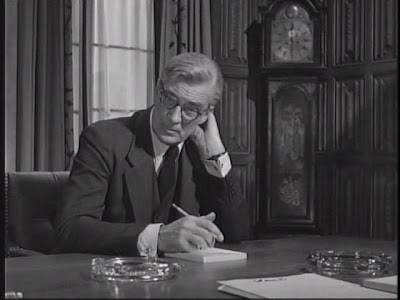 Bullard's number two man Alderson (Walter Pidgeon) is a nice but inadequate fellow who is probably fit for the number two spot but not as the head honcho.
 VP Loren Shaw (an excellent Fredric March) is the heartless and cold comptroller of the company who is only concerned with the bottom line.
  William Holden nicely plays VP McDonald Walling who is in charge of research and development; Walling goes way back with Bullard and has always had a free hand to develop new, artistic creations -- UNTIL beancounter Shaw gained Bullard's ear. Now Tredway is making increasingly shoddier product (it is referred to as cheap, embarrassing and junk at various points during the film) and Walling has been getting frustrated at the downturn of Tredway's "integrity" as a company.
  Walling's wife Mary (a surprisingly sexy this time June Allyson -- who knew she was rockin' some hot abs?!?!) urges him to quit rather than "die a slow death" at Tredway.
  Another disillusioned VP is Jesse Grimm (crusty Dean Jagger) in charge of manufacturing; Grimm is planning to retire and chuck the company.
  Next we have pat-you-on-the-back sales VP Josiah Walter Dudley (Paul Douglas) who has had to sell the rather inferior product not on its merits but on the quality of his scotch and his winning personality. Married Dudley is having an affair with a secretary
  (an unusually reigned-in performance by Shelley Winters who shines in her rather small role) and is planning on sneaking off for a romantic weekend when Bullard's board meeting is called. The last major player is Julia Tredway (a slightly manic Barbara Stanwyck) who is the daughter of the company's founder and consequently owns a HUGE HONKIN' CHUNK of Tredway stock.
 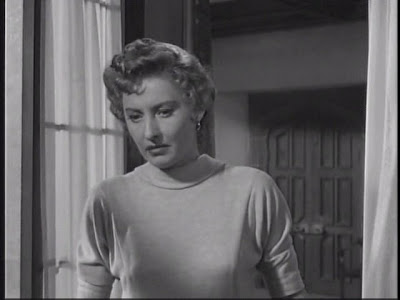 Tredway's father apparently jumped out the window during a past financial crisis and Bullard took over the company and served as a father figure (or possibly MORE -- that's never made clear) for Barbara Stanwyck's character. Unfortunately, in recent years Bullard has grown distant from Julia causing her to look longingly out office highrise windows from time to time as if contemplating daddy's choice for herself.
 EXECUTIVE SUITE shapes up with twists and turns aplenty providing lots of drama in the board room. It's quite like a gripping courtroom drama only without the court room. This is the cutthroat world of high finance and everybody's got something up their sleeves. Performances are uniformly excellent by the entire cast. My only slight quibble is that the final resolution of the film seems a little rushed. But with this tiny quibble hardly worth mentioning, I highly recommend you take a look at this film and see who does what to whom and why.


 Accomplished graphic artists in their own right, the creators of this DVD has made wonderfully whimsical cartoon menus and the DVD itself is split up into three acts (not including a generous side of special features).
 Highlights of the disc include the 1907
  Two 1928 Felix the Cat cartoons are included:
  The expressionistic
  1930's


 Then we are treated to some actual REAL prevues of coming attractions including an old "Spook Show" trailer as well as a lengthy trailer for one of the worst movies ever made: Dwain Esper's fleapit extravaganza
 Two Tom & Jerry cartoons from the early 30's
 THE GHOSTS' HIGH NOON is in fact a 2006 "music video" animated by the DVD's creators to the music from
 Gilbert & Sullivan's "The Sorceror's Song" (kindly including on screen lyrics) as well as one of my personal favourite songs of all time: Harry Reser's "Mysterious Mose". All these songs are illustrated by on screen animations and movie posters, etc.
