Tuesday, October 05, 2010


 Pixie, kobold, elf, and sprite

 Only the third Universal talking horror film, RUE MORGUE follows the one-two punch of DRACULA (1931) and FRANKENSTEIN (1931); if those two films were home runs then MURDERS IN THE RUE MORGUE is more like a bunt. (EDITOR'S NOTE: Please excuse the baseball reference, I swear it'll never happen again.) Of course, the film is (very loosely) based on Edgar Allan Poe's groundbreaking detective story which created the entire genre of detective fiction already. But the real behind-the-scenes story of the film is really a lot more exciting than the actual movie. Of course, we all know that after DRACULA was such a big hit for Universal Studios (in fact, pulling them from the brink of bankruptcy), Bela Lugosi was slated to appear in the follow-up FRANKENSTEIN as the monster with Robert Florey directing. The now-legendary screen test of Lugosi in monster makeup reminiscent of THE GOLEM (1920) seems to have been criminally lost to us. Then at some point, Bela turned down the role of the monster because there were no lines. Actually, at that point it was probably a wise thing for Lugosi to do. It was only later when Universal removed Florey and installed James Whale in the director's chair that the role morphed into something which would make Boris Karloff a star. But by then it was too late. Robert Florey was given MURDERS IN THE RUE MORGUE as a "consolation prize" and Lugosi was tapped to star as the maniacal Dr. Mirakle.
 The movie itself, as I've already hinted at, is not a classic. However, there are several things going for it. First and foremost, of course, is the performance of Bela Lugosi in o
 ne of his most memorable characterisations; sadly there are great stretches of the film in which Lugosi does not appear. That would be one of the things going against it. These scenes are left to be carried by top-billed (!) silent film holdover Sidney Fox as the rather insipid heroine Camille and the slightly better Leon Ames (before he changed his screen name from Leon Waycoff) as Pierre. Admittedly the script doesn't give them a lot to work with but both actors are still clinging to the over-emphasized silent screen style of acting.
  Another of the film's plusses is the often superb cinematography by maestro Karl Freund who squeezes every ounce of chiaroscuro mood as possible out of every scene. Universal staff art director Charles D. Hall also provides some quite stylised (almost surreal at times) sets for Freund's camera to sink it's teeth into. Another plus seems to be the "additional dialogue" credit of a young pre-director John Huston. The film is sprinkled with very witty lines which I suspect must be the work of Huston. The job of directing by Robert Florey is somewhat more problematic to judge since the current cut of the film is not what Florey intended; the studio recut the film and shuffled scenes into different running order. This may be why the film itself seems to play rather oddly when one watches it. In fact, the opening scene of the film was supposed to be the celebrated foggy-night street fight witnessed by "woman of the street" Arlene Francis (decades before her regular stint as a panelist on "WHAT'S MY LINE?") where Lugosi's carriage (driven by Noble Johnson) pulls up and abducts her. This scene is pushed forward a good 15 minutes and has to wait until after we see the carnival scenes where Fox, Ames et. al. go to see Erik the Ape in Dr. Mirakle's sideshow. With that knowledge, one can now see how the particular camera shots which reveal both Noble Johnson and Bela Lugosi in the foggy night fight scene are specifically filmed like they are the first introduction of the characters in the film. Which they originally were. The opening carnival scenes with Lugosi are, truth be told, also quite good and atmospheric, but they certainly don't "introduce" Lugosi the way the "carriage" shots did.
  And the fact that the abduction and subsequent torture and murder of Arlene Francis (strapped to an almost-crucifix) were scenes originally meant to play BEFORE the carnival scenes where Erik snatches Camille's bonnet, any real sense of dread has been largely dissipated. If we the audience had seen what Dr. Mirakle was capable of in his elimination of Arlene Francis BEFORE his encounter with Sidney Fox, we would feel a lot more uneasy upon seeing Lugosi's newfound interest in young Camille.
 All that having been said, the plot of course concerns Dr. Mirakle's quite dotty attempts to prove man's descent from the apes by mixing the blood of humans (make that the blood of sweet young thaaaaaangs) with the blood of Erik the Ape. As if THAT ever had any real chance of scientific success! As I've said, lovers Pierre and Camille (accompanied by their dippy posse) see Mirakle and Erik at a sideshow where the ape takes Camille's bonnet. Later Mirakle encounters a prostitute on the street, whisks her back to his secret laboratory and sadistically tries to mix her blood with the ape's. Unfortunately, the hoyden's blood is "bad" (she does habitually do the nasty, after all) and her dead body is dumped through the floor into the Seine to be discovered by police. Here is another instance where the studio reshuffle of scenes doesn't work. The death of the prostitute with bad blood (who "spoiled" Mirakle's experiment) should come first since now the doctor has realized he must search for some "pure" (read that as "unsullied by the naughty embrace of men folks") blood. THEN his interest in Camille upon seeing her at the sideshow takes on major overtones which are non-existent in the current cut of the film.
  Anywho, after the murder of the "woman of the streets" and the discovery of the body, the movie hits a brick wall of boredom with several scenes devoted to the wet romance of Pierre and Camille. But before that, one of those nice little dialogue things happens as the police pull Arlene Francis' body from the Seine. An old gypsy woman watching nearby soliloquises: "Life is hard. The river is kind. The river is soft. It rocks them to sleep." Things pick up greatly, however, when Mirakle finally decides to send Erik into the apartment Camille shares with her mother and kidnap the young lady. During the abduction, Mother is killed. However, when Pierre and the local gendarmarie bust down the door only minutes later, the apartment is completely empty. A nice bit of business involving conflicting witnesses stating they heard the kidnapper's voice follows: they all swear it was a foreign language. A German man swears it was Italian, an Italian man swears it was Danish and a Danish man swears it was German. It's been many moons since I've read the Poe short story but my dim memory seems to tell me this scene was taken directly from the story. This is a nice touch. Pierre insists that, while one of the women must have been carried off by the kidnapper, the other must have been murdered and is still somewhere hidden in the apartment.
  Eventually, they find Mother's corpse stuffed upside-down inside the chimney; the shot of her hair streaming down works extremely well and is probably the only real "shock" in the film. The gendarmes and Pierre quickly track down Erik carrying Camille over the Parisian rooftops (a full year before a similarly hirsute-albeit-larger resident of Skull Island carried another ingenue to the top of another building) where the ape is shot dead, tumbles to the Seine and the status quo (for 1845 Paris) is restored.
 In comparison with most of the other classic Universal horrors of the same era, MURDERS IN THE RUE MORGUE must necessarily suffer. It's simply not in the same league as DRACULA, FRANKENSTEIN, THE MUMMY, THE INVISIBLE MAN or THE BLACK CAT. However, when watched on its own -- and not in the company of those other films -- it is watchable (especially if one fast-forwards through the courtship nonsense about a half hour in). Truth be told, however, RUE MORGUE actually IS on a par with something like THE WEREWOLF OF LONDON in the second tier of the first wave of Universal horror. And in that alone it's a welcome viewing edition to the Halloween season.
 Monday, October 04, 2010
 DR. SHOCK'S HALLOWEENIE MOVIE OF THE DAY: THE HIDEOUS SUN DEMON (1959). Tom Selleck loves this film. He says it's neat. I wouldn't go that far. However, I wouldn't go as far as those who condemn it as totally inept and unwatchable. In fact, it's quite watchable with practically no draggy places in it. It is inept, however. But hey, at least it's more entertaining and a lot less draggy than IRON MAN 2! This was the brainchild/labour of love of minor character actor Robert Clarke who produced it, directed it, co-wrote it, starred in it and, for all I know, cooked lunch for the craft service table! He also filled the cast with sisters-in-law (TWO of them), his mother-in-law and countless other friends and family. This is truly what my late friend Peg used to call "a lunchtime production": that is, a group of people had a lunch hour free so they made a movie. Literally, THE HIDEOUS SUN DEMON was shot on weekends while Robert Clarke was working on other pictures during the week. The camera equipment was cleverly rented on Friday so they got the use of it for an entire weekend but only had to pay for one day. Having said all this, THE HIDEOUS SUN DEMON is actually a helluva lot better than it has a right to be. Oh yeah, and besides that it's got a terrific movie trailer (which in the tradition of most low budget horror movies is much better than watching the whole movie itself) with bombastically beautiful narration by "The Man With 1,000 Voices": Paul Frees!

 Robert Clarke plays an atomic scientist (is their any better fifties occupation?!?) named Gil (this name will become amusing once one sees his appearance as the hideous sun demon) who gets zapped with radioactivity. While in hospital, he discovers that exposure to direct sunlight causes him to transform into a scaly reptilian creature who likes to rampage like it's nineteen fifty-nine. The sky was NOT all purple, however. Gil's rather understanding girlfriend Ann (Patricia Manning) handles all this a lot better than some might. However, Gil decides that turning into a lizard-like freak gives him a mahhhhhhhhhhhhty thirst so he heads down to the local bar for a drink. It's ok, it's nighttime. He'll be alright. There he encounters a busty bar singer named Trudy (Nan Peterson: my favourite person in the film for some reason) who sings (in dubbed voice) the song "Strange Pursuit". And she must sing the hell out of it because Gil goes away but comes back again the next night to take Trudy in his little sports car (complete with built-in booze cabinet) cruising down the Pacific Ghost Highway. They eventually come to a beach and Gil suggests they take off their shoesies and run down to the water. Gil grabs her and makes a quite violently animalistic pass at Trudy. She slaps his face, he pushes her into the water, she gets
 up and laughs. This apparently is the tried and true correct response to attempted rape. Before too much more time goes by, Trudy is out of her dress and wrapped in a blanket, then wrapped in Gil's coat, then minus the blanket. A discreet fade out indicates Gil and Trudy are engaging in a roll in the hay. Er....sand. Gil awakes to find the sun is up. He runs up to his car and races away before the effects of the sun make him go all funny. Yes, he has abandoned Trudy miles from nowhere. But she's a tramp, it's the best she deserves. Remember, it's 1959. Gil goes back home and Ann finds him hiding in a closet. Crouched down cowering, if you wanna know the truth. You know, Gil doesn't come across as the most likeable person in this movie. In fact, as atomic scientists go, Gil is about on par with the nutty medico in THE BRAIN THAT WOULDN'T DIE in the likeability department . . . especially in his attitude towards women! The hell with him, I say. Tie him down under a sun lamp. Well, being the incredibly brainy atomic scientist he is, Gil goes back to the same bar where he picked up Trudy and Trudy just HAPPENS to be there with her gangster boyfriend George and his thug pals who naturally beat the snot out of him. YAY for them! Of course, after this episode Trudy (who has just angrily thrown her drink in Gil's face and watched at least 4 guys beat the guy up) promptly brings Gil back to her apartment in puts him into bed.
 The next morning Gil wakes up, Trudy gets frisky, her gangster boyfriend shows up, there's another fight, George pulls a gun and attempts to take Gil "for a ride". Outside Gil transforms into the hideous sun demon and kills George while Trudy (and her bust) hang out the nearby window screaming. I mean to say Trudy screams. I don't know WHAT her bust is doing. You be the judge. Have I mentioned that Nan Peterson is my favourite person in the movie??? Anyway, a bunch more stuff happens. Gil hides in an old shack near an oil rig and is offered cookies by a little girl (no, NOT Marilyn Harris!). The little girl's mom calls the cops, cops chase hideous sun demon, cop shoots hideous sun demon, hideous sun demon dies. Not exactly the most powerful or implacable monster if one shot from a gun pretty much does it for him.
 Kudos much be given to Richard Cassarino (billed as Gianbatista Cassarino -- a much more fun name) who created the wonderful Sun Demon mask for a measly 400 bucks! When one looks at the monster make-up in a lot of low budget movies of this time period, the Sun Demon mask is rather impressive. And it's iconic -- see -- it made the cover of "Famous Monsters", didn't it?!? The acting of Robert Clarke a little less so. Never that much of an actor, Clarke several times resorts to shrieking histrionics reminding me of Michael Landon's "you've gotta help me doctor please help me" tirade in I WAS A TEENAGE WEREWOLF. A little bit much.
  But you've got to hand it to him; Robert Clarke gave this movie his all. His goal was to cheaply make a monster movie that may not be too good but will hopefully make a lot of money. Sadly, a series of circumstances led to Clarke losing ownership of the film but he still proudly trumpeted the film until his death. Oh yes, and as for that Tom Selleck comment. . .I wasn't making it up. In 1997, Tom Selleck told "Entertainment Weekly" THE HIDEOUS SUN DEMON was "my guilty pleasure. It's a great '50s horror movie about nuclear radiation and mutation. It's about this guy who turns into a lizard if he goes out in the sun. And that was really neat." So c'mon Tom . . . how about doing a remake????
 Sunday, October 03, 2010
 It hard to name one particular Hammer Frankenstein film as the best but many consider this to be it. I particularly like the sets in this one (Cheers Bernard Robinson!).
  The superb basement laboratory beneath Anna's house is to me the quintessential Baron Frankenstein's working lab. This is the fifth installment in Hammer's Frankenstein series and Peter Cushing is the most chillingly icy and malevolent that he's ever been! The opening scenes in which someone we presume is Baron Frankenstein is racing around decapitating unsuspecting doctors is interestingly shot by director Terence Fisher; we basically only see Frankenstein's feet. It is indeed then quite a jolt when the camera finally pans up to the face and we don't see Peter Cushing at all but a weird bald grotesque maniac! Of course, it turns out it IS Frankenstein all along but just
 in a rubber fright mask. A quick thumbnail of the plot finds our manipulative Baron Frankenstein blacklmailing a young doctor named Karl (Simon Ward) and his fiancee Anna (Veronica Carlson) the insane Dr. Brandt (George Pravda) in order to transplant his brain into another body (Freddie Jones) in order to obtain secret mad doctor-type knowledge. But all this is secondary to the fiendish fun. Cushing really drips venom in this portrayal. Simon Ward (whom I've always thought of as looking like a young, blond and thin Peter Lorre) and Veronica Carlson are actually quite excellent in their hapless roles as puppets of the Baron. Freddie Jones, as usual, is wonderfully pathetic (and sometimes quite fruity) as the tragic "creature" and veteran Hammer character stalwart Thorley Walters is memorably exasperating as the deliberately annoying and condescending Inspector Frisch.
 Terence Fisher's direction is particularly brisk this time around and avoids the infamous "Hammer lull" which plagues the middle of quite a few Hammer Horrors. The musical score by James Bernard is also quite memorable. The one sour note in the entire production is the infamous rape scene which was imposed upon the director and stars at the last minute in a boneheaded attempt by the head honcho to inject more sex into the film; Fisher, Cushing and Carlson all protested violently against the scene but were forced to shoot it and, admittedly, it plays like just what it is: a stupidly out-of-place (and out-of-character for the Baron) misstep which briefly brings the film to a crashing halt. Luckily DVD technology allows one to skip over it; this lets the viewer take on the role of film editor and produces a superior cut of the film with this one scene missing.
 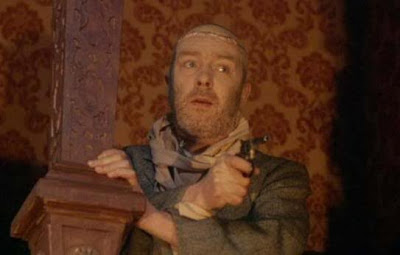 All in all, FRANKENSTEIN MUST BE DESTROYED is right up there in the top 2 Hammer Frankensteins, I think. A real corker.
Saturday, October 02, 2010
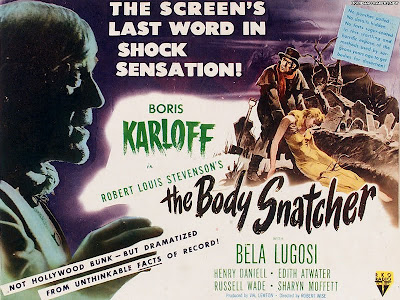
 In a career that caused him to run around in an ape skin (Monogram's The Ape) and to engage in games of musical brains (Universal's House of Frankenstein or any number of poverty row mad doctor flix), Boris Karloff could well be pleased at having been cast in "The Body Snatcher". His casting, however, owed nothing to producer Val Lewton. Karloff was assigned to the film by RKO in an attempt to compel their maverick producer to make full-blooded, ticket-selling horror shows instead of the subtle, subversively thoughtful psychological mood pictures Lewton was turning out. Forcing the King of all horror actors to Lewton's next production, an adaptation of Robert Louis Stevenson's macabre short story, would seem to leave the producer with no choice but to make with the blood and thunder. The studio had yet again underestimated their producer.
 No doubt Lewton was well aware of what they were trying to do and the producer was only slightly happier to be saddled with Karloff than was Michael Reeves when he got news that Vincent Price was going to be his Witchfinder General. Karloff starred in all those Universal monster romps that Lewton was deliberately rebelling against with his moody series of chillers starting with "Cat People". Kid's stuff. What was he going to do with the Baron of All Boogeymen?!?
Karloff acts the part of Gray with what I can only describe as relish. This is not to say with dramatic scene-stealing. Boris is subtle and subdued; never reaching for a scene but still almost incendiary. Karloff's eyes spark with evil fire while at the same time chilling to the bone. Never once does one catch Karloff "acting"; he inhabits the role and becomes genuinely unsettling with equal parts charm and threat. Nowhere is the duality of Gray's Janus-like  character on fuller display than when he murders Joseph (the dim-witted handyman/blackmailer played by Bela Lugosi). Joseph works for the anatomist Dr. Macfarlane (the exceptional Henry Daniell) who pays Gray to grave rob corpses for his school of dissection. Joseph knows that Gray kills some of the corpses himself and demands money to keep silent. A steeliness comes into Karloff's eyes as he ascertains that Joseph has told no one he's come to see Gray. Then Karloff turns on the wicked charm, plying Joseph with drinks and disarming him with song and story about Burke and Hare. Gray suggests that he and Joseph go into business together "Burke-ing" people to provide Dr. Macfarlane with his corpses. Joseph doesn't understand what Gray means and asks him: "Tell me plain how they did it." We've all seen the scene an hundred times but it's still impressive. "I'll show you how they did it, Joseph," Karloff smiles with firelight dancing in his eyes. Astonishingly, Boris manages to convey friendly camaraderie combined with deadly menace. He somehow allows the audience to see what's in Gray's mind without any obvious acting trick one can point to. It's the subtlest acting job I've ever seen and I can't think of another actor before or since who has matched it. Two mutually exclusive emotions are conveyed to the audience without any concrete facial changes to telegraph them. Karloff is almost like a snake charmer or a hypnotist; if we were in Joseph's place we would probably know exactly what Gray was going to do to us but we would still let him do it. So powerful and persuasive is Karloff's performance and this is just one scene in the movie. It's the most famous scene for a reason and that is in Karloff's performance. It's the perfect example of the seductive attractiveness and power of evil.
 Bela Lugosi is second-billed after Karloff but his role is more like a guest star. This is no disrespect to Lugosi whose performance as Joseph is excellent. However, the part is much smaller than Henry Daniell's Dr. Macfarlane and Russell Wade as his assistant Fettes. "The Body Snatcher" can in no way be called an equal co-starring picture between the two horror giants like many of their Universal partnerships in the past. However, Bela does the best he can with such a small role and the duo's final screen pairing is satisfying if brief.
 Speaking of Russell Wade -- his is the voice that calls over the cemetery wall to Consuela promising to fetch her a ladder in Val Lewton's "The Leopard Man". Consuela gets killed and Wade gets a bigger part from Lewton in "The Body Snatcher". Wade's Fettes is sympathetic and believable; he demonstrates a winning bedside manner (as well as a strong resemblance to Robert Taylor) with the little crippled girl played by Sharyn Moffet (who almost played the lead in "Curse of the Cat People" before losing the part to the equally talented child actor Ann Carter). Fettes constantly protests Macfarlane's shady tactics and appears altruistic; but it must be said that, however much he protests, Fettes continues to go along with it all. He's not quite the boyscout he appears to be. When Dr. Macfarlane tells Fettes that he has to keep helping him because Fettes' handwriting is in the log book accepting delivery of a murdered corpse from Gray, Fettes continues to aid and abet the doctor. However, a moment's thought should tell Fettes that a simple toss of the log book in the fire would remove any evidence of his complicity. If Fettes really wanted to stop helping Macfarlane, he could at any time. Even after Macfarlane's wife convinces him to leave the doctor's employ, Fettes jumps in a carriage and travels for miles just to tell Macfarlane that his operation on little Sharyn Moffet was a success. Talk about a flimsy excuse to see the doctor again! Fettes' secret desire to help Macfarlane is crystal clear when the doctor suggests they go dig up a body themselves. Fettes frowns and makes a sour expression but the scene cuts to Fettes frantically shovelling a grave while Macfarlane looks on. Fettes' altruistic protests are too faint to fool anyone but himself. This kind of depth of character makes Fettes more than just the typical bland hero and Wade's performance of it is solid throughout.
 This brings us to Henry Daniell whose typical imperiousness is perfect for the commanding Dr. Macfarlane. "Toddy" is a cold fish with a rock solid opinion of his own greatness. However, when Gray is around this granite facade crumbles and Toddy allows himself to be manipulated by Gray with only the smallest token of resistance. Daniell's performance gives the unlikely scenario believability and we catch glimpses of the vulnerable insecurity hiding behind the bullying bombast. This is probably the greatest role of his career (certainly in horror films) and Daniell rises to the occasion. After his operation on the little girl appears to have failed, Macfarlane even temporarily drops the sparring match with Gray: he invites the body snatcher to have a drink with him with obvious sincerity and tells Gray his troubles (as if they actually were the old friends Gray keeps insisting they are). This thaw doesn't last long, of course, but we do get another glimpse behind the doctor's mask.
 Robert Wise ably directs with a sure hand; letting his actors do what they came there to do and do it extremely well. The film features several unforgettable set pieces: the pathos of the little dog refusing to leave his master's grave, Gray's savage killing of the dog with a shovel, the sudden murder of the street singer, the aforementioned Karloff-Lugosi "Burke" scene, and the final rainy carriage ride. These scenes are masterfully composed and shot.
Val Lewton’s themes come across loud and clear in "The Body Snatcher". Life’s meaninglessness is demonstrated unambiguously by the cheapness with which it is held by both Gray and Macfarlane. The doctor pontificates about the progress of medical science benefiting all mankind and then refuses to cure a little girl’s paralysis because he’s too busy teaching medical school. Gray, of course, sees people only as a ten pound sale as a cadaver. He listens to the sweet voice of the street singer appreciatively and then swiftly bumps her off. In perhaps the greatest depiction of Gray’s dual nature, Karloff brutally murders Joseph and, almost in the same moment, tenderly pets his cat with the same hand he just used to kill a human being. Total disregard for the sanctity of human life co-exists paradoxically along with a strange kind of tenderness.
Robert Wise ably directs with a sure hand; letting his actors do what they came there to do and do it extremely well. The film features several unforgettable set pieces: the pathos of the little dog refusing to leave his master's grave, Gray's savage killing of the dog with a shovel, the sudden murder of the street singer, the aforementioned Karloff-Lugosi "Burke" scene, and the final rainy carriage ride. These scenes are masterfully composed and shot.
Val Lewton’s themes come across loud and clear in "The Body Snatcher". Life’s meaninglessness is demonstrated unambiguously by the cheapness with which it is held by both Gray and Macfarlane. The doctor pontificates about the progress of medical science benefiting all mankind and then refuses to cure a little girl’s paralysis because he’s too busy teaching medical school. Gray, of course, sees people only as a ten pound sale as a cadaver. He listens to the sweet voice of the street singer appreciatively and then swiftly bumps her off. In perhaps the greatest depiction of Gray’s dual nature, Karloff brutally murders Joseph and, almost in the same moment, tenderly pets his cat with the same hand he just used to kill a human being. Total disregard for the sanctity of human life co-exists paradoxically along with a strange kind of tenderness.
 The other perennial Lewton theme, that of each person being doomed and racing towards their own death, can be seen in virtually every character from the doomed little dog guarding his master’s grave to the unbending Dr. Macfarlane himself. The street singer is doomed simply because she’s there. Gray is doomed because he won’t ever release Macfarlane from his manipulative power. Joseph is doomed because he sees too much and attempts blackmail. Mrs. Macfarlane is doomed to watch her husband destroy himself and their life together. Even Fettes must surely give up any hopes of becoming a doctor as he is left at film’s end with a crashed carriage and two corpses to explain: one of which he obviously helped grave rob. Not the best of resumes for a general practitioner then or now. A grim hopelessness penetrates the film from beginning to end. We never for a moment expect any sort of happy ending. We can only watch, just as the characters themselves hopelessly and powerlessly watch their own lives go down in ruin.
Val Lewton may not actually have saved Boris Karloff’s soul by starring him in "The Body Snatcher", but he did provide the actor with one of the greatest roles of his career. Lewton managed to do all this and still thwart RKO’s desire for a rootin’-tootin’ monster rally. Producer: 7, Studio: Nil.
The other perennial Lewton theme, that of each person being doomed and racing towards their own death, can be seen in virtually every character from the doomed little dog guarding his master’s grave to the unbending Dr. Macfarlane himself. The street singer is doomed simply because she’s there. Gray is doomed because he won’t ever release Macfarlane from his manipulative power. Joseph is doomed because he sees too much and attempts blackmail. Mrs. Macfarlane is doomed to watch her husband destroy himself and their life together. Even Fettes must surely give up any hopes of becoming a doctor as he is left at film’s end with a crashed carriage and two corpses to explain: one of which he obviously helped grave rob. Not the best of resumes for a general practitioner then or now. A grim hopelessness penetrates the film from beginning to end. We never for a moment expect any sort of happy ending. We can only watch, just as the characters themselves hopelessly and powerlessly watch their own lives go down in ruin.
Val Lewton may not actually have saved Boris Karloff’s soul by starring him in "The Body Snatcher", but he did provide the actor with one of the greatest roles of his career. Lewton managed to do all this and still thwart RKO’s desire for a rootin’-tootin’ monster rally. Producer: 7, Studio: Nil.
 A couple years ago I did one but since then, due to one series of circumstances after another, I have not been able to repeat the project. However, the last two years I made an announcement each year stating that I could not do it. And you will notice I made no such announcement this year. That doesn't mean I've forgotten about the entire thing. It just means simply that I'm not sure whether I can pull it off due to the previous two months of ill health resulting in the impossibility of any and all preparation time. Also an issue with a new server recently installed at work left a question mark as to whether or not I would be able to access blogger at all. Well, it seems like I will. Therefore it may just be possible. Does this mean I am officially declaring a 2010 daily Halloween Countdown in the Land of Cerpts and Honey. Well, no. Simply because I have done no preparation beforehand (due to the aforementioned bout with the Lurgi). There still remains the question of whether or not I will be able to physically or logistically post every single day. However, since it's not official there's nothing to stop me from trying. Unofficially, that is. In fact, it began unannounced yesterday with that series of nice Halloweenie youtube posts for you to watch. So, if we get to October 31st and I have posted Halloween stuff every day of the month (or almost everyday) then retroactively it will have been an official Halloween Countdown. If not, then you'll get a trick or treat bag full of many Halloweenie-type posts. Either way you win. Or lose. Depending on your opinion of my blathering blog. Just keep in mind -- you are not allowed to read this blog unless you're wearing your Halloween costume. I'm not giving out freebies, you know!