The 1966 cult film MODESTY BLAISE is something most viewers either love or hate. There seems to be no middle ground where this film is concerned. Released at the height of the swinging sixties, director Joseph Losey's adaptation of Peter O'Donnell's popular comic strip has really very little to do with its source material. This seems to be a major bone of contention with Modesty Blaise fans who have been known to refer to the film as "Travesty Blaise". Equally fervent are the film's cheerleaders who find the wacky 60's pop art style makes MODESTY BLAISE a camp comedy classic.
  Femme Fatale Modesty Blaise (Antonioni muse Monica Vitti) is brought in by the British government to help them foil a diamond theft. Along the way are a series of spy-type situations involving Bond-villain-like Gabriel (a silver-wigged Dirk Bogarde). That's basically it. You see, there IS a plot. But that is only an excuse to set the movie in motion. Any thought of a literal translation of O'Donnell's strip should be quashed immediately when we see Modesty change her hair colour and wardrobe in the blink of an eye. Literally. Snap your fingers and she goes from blonde to brunette. We're not dealing with reality here; this is a surreal exercise in go-go-checked, day-glo pop art from deep in the heart of the groovy sixties. Yes, there is a deliberate surreal quality to the film which cannot be ignored.
  The clothes, the decor, the furniture, the gosh-darn lamps -- the film looks truly wonderful (in a nice, crisp print like the one I screened) as an over-the-top depiction of 60's ginchiness. The acting (for the most part) is funny because it's played straight without a knowing wink at the audience; the possible exception being Vitti herself who sometimes has her tongue jammed a little too far in her cheek.
  Dirk Bogarde is an absolute joy as the effete master criminal Gabriel -- he even tells Modesty at one point that he is the "villain of the piece" in a voice that fairly purrs -- and the film is worth watching for him alone if for nothing else. But there is plenty more to watch. Clive Revill has a dual role as Gabriel's accountant-like odd sidekick McWhirter (which Revill plays very straight) and Modesty Blaise's adopted sheikh father Abu Tahir (which he plays very broadly). Modesty's partner in crime Willie Garvin is quite nicely played by a bronzed Terence Stamp who never asks anyone to kneel before him once. Reliable Harry Andrews as British gov functionary Tarrant sends Modesty on her mission while Rossella Falk plays the psychopathic Mrs. Fothergill. The late Johnny Dankworth provides the suitably swinging Eurospy spoof music and Jack Hildyard lenses the film beautifully; some of the psychedelic interior sets can actually be tasted if you lick the TV screen. Tastes like candy, you dig?
  Circumstances were such that I was forced to watch the film in two sittings: half one day and the other half the next. I must admit that the film annoyed me when I sat down to watch the first half. However, the next day when I took up the film again in the middle I quite enjoyed it. There can be no greater warning to the casual viewer that it will probably depend on your mindset at the exact moment when you sit down to watch it whether or not you will enjoy the film. If I had watched the entire film when I started it, I probably would be telling you now I hated it. However, if I had watched the whole film from start to finish the second day, I'd probably be raving about it. Suffice it to say that, as things now stand, I quite enjoyed it in a cotton candy kinda way. As ever, I am the square peg in the round hole because, unlike most I neither love nor hate the film. I enjoyed it fairly well while in a certain frame of mind but that's about as far as I'd go. The direction by Losey could've been better; another director would've made the film probably a more satisfying experience. Monica Vitti (who I love) seems like perfect casting in the role and she looks marvelous; however her "superspy" skills leave a lot to be desired.
  As a formidable femme fatale, Vitti's Modesty Blaise is rather hopeless having nary an action scene with very little evidence of fighting skills or weaponry prowess. She also seems to cower a lot while Willie Garvin gets her out of some scrapes. Not the capable heroine we are expecting. Perhaps it was the time period OR the multiple attempts at a screenplay OR the failings of the director OR most probably all three. However, none of this really matters since the original Modesty Blaise concept is only the bare bones skeleton on which to hang a sixties camp romp.
  MODESTY BLAISE is simply a movie which could not have been made a few years before OR a few years after 1966. Before that year, the style and concepts of the film would've been incomprehensible and by the late sixties the film would've been impossibly innocent and naive. As such, MODESTY BLAISE is a slight but valuable glimpse at a brief moment in time.


 However, it is only the first of about 3 or 4 documentary television series which made a huge impact on my life. I love documentaries an
 CIVILISATION burst forth in glorious colour in 1969 on BBC-2 in a deliberate effort to bring colour television to the masses; up till then the idea of colour TV was held to be a dubious prospect with fears of garish colour dragging down all efforts. However, David Attenborough, then head of BBC-2 programming, was determined to do colour and do it right. He therefore set about launching an arts programme in cohoots with director Michael Gill and co-producer Peter Montagnon to be shot in incredibly-more-expensive 35mm. But who to write and host the thing? Attenborough had no other thought than Sir Kenneth Clark (later Lord Clark) whose impeccable reputation as a preeminent scholar (based on seminal books on Leonardo and "The Nude") seemed ideal. Sir K, however, was a bit of a hard sell. For some reason, he had gotten it into his head that his fast approaching 70th birthday would spell the end of any and all meaningful contributions to art scholarship. His wife, Lady Clark, also was dead set against his wasting time on a television series while there were more "important" projects her husband could be devoting himself to. Sir K actually turned the TV project down . . . gently and none too definitively. A lunch in the BBC canteen convinced Clark that the Beeb was solidly behind the project and he relented; especially when the concept of the series being "a personal view" was floated. This would eliminate Sir K's reservations as to how he could possibly cover everything in a 13-part series. Whatever didn't fit (such as most of Spain's contribution to Western Art) was simply ignored! Yes, they got a lot of stick for that policy but there was really no other way to carry on with the series.

 The other aspect of the series that cannot be overstated is the wealth of marvelous art lovingly poured over by the camera. Some wag at the time poked fun at the series by lampooning Clark's on screen hosting in this way: "Here I am in front of the beautiful gothic Cathedral of X which you can't see because I'm standing in front of it". This, of course, isn't true. . .we always get a supremely good look at every painting, sculpture and building. Then there is also the extreme care taken with the music; chosen from the same time period as the artwork we are seeing and complimenting the visuals perfectly in every instance. When it comes to that rare instance when civilisation brings us to England, Clark presents Shakespeare to us by actually presenting Shakespeare -- we get renowned Shakespearean actors like Eric Porter and Ian Richardson (as well as an unbilled, impossibly young Patrick Stewart) performing scenes from KING LEAR, MACBETH and HAMLET. The HAMLET sequence in particular has always been a favourite of mine and I wish the BBC had filmed a complete Richardson HAMLET performance of the play at the time. Hell, Sir K even manages to make my intense dislike for Rococo art mellow to a mild distaste. That's the mark of a true miracle worker!
 CIVILISATION is a treasure trove of Western art and one can only wish in vain that there had been 26 episodes instead of a mere 13. The series was not only a very respected triumph in TV programming but it was also a huge hit with the casual viewer. Attenborough describes (in a new interview on the dvd) how, at the time, the rarity of households with colour TV sets saw the rise of "Civilisation viewing parties" each week as friends and neighbours would gather to watch each new episode -- and Attenborough sneakily got round the huge budget the programme was costing the BBC by scheduling each episode to air twice in one week thereby halfing the show's budget. Sir K also travelled to America where the series was shown multiple times a day in Washington's National Gallery. Lines stretched around the block and Clark was cheered, applauded and swarmed by an admiring public. So great was the adulation by the "man in the street" ordinary viewer that, according to his memoirs, Clark had to hide himself away in the men's room where he sat and wept for 15 minutes before composing himself. Such warmth and appreciation from the TV viewer was well-deserved. CIVILISATION, even today, stands as one of the finest, most satisfying television experiences ever aired.
  As you may already know, our friend Weaverman
  "This is the case of Armand Tesla, vampire, as compiled from the personal notes of Professor Walter Saunders, Kings' College, Oxford. The following events took place on the outskirts of London towards the close of the year 1918. They began on the night of October 15th; a particularly gloomy, foggy night that was well-suited for a visitation by the supernatural." This visitation was enabled by Columbia Pictures Studios under the direction of Lew Landers as the 1943 spookfest called "The Return of the Vampire" starring Bela Lugosi as Dracula in all but name. We're all familiar with Lugosi's historic turn as the vampiric Count at Universal Studios in 1931; a turn which would effectively save Carl Laemmle's studio from bankruptcy. Bela would be unceremoniously dropped from the sequel "Dracula's Daughter" in 1936; replaced by a waxworks dummy in the scene where Gloria Holden commits his body to the fire. In fact, in the very same year of 1943, Universal would deliver another vampire film (Son of Dracula) and cast their new horror favourite Lon Chaney Jr. as the slightly over-fed Count Alucard without seriously considering Lugosi for the role. Perhaps poetic justice guided the hand of Columbia Pictures in their effort to make their own Universal-like Dracula film; calling it "The Return of the Vampire" and starring Bela Lugosi would naturally clue in the prospective audience that Dracula was back. So who was this Tesla guy? Well, naturally Columbia wouldn't dare call him Dracula and draw down the wrath of Universal's potent legal department. So, an alias was in order; fitting considering Tesla himself masquerades as Dr. Hugo Bruckner throughout the film.
 So there we have it: an opening narration related about about the mysterious events in 1918. Matt Willis as Andreas (perhaps the most lovable werewolf ever in movies with his puppy dog nose and happy, fanged grin) creeps through a foggy graveyard (that almost out-Universals Universal for sheer atmosphere) on his way to a subterranean tomb to wax eloquent to the coffin of Armand Tesla. And it's really a heckuva speech provided by either screenwriter Griffin Jay or else more probably by Randall Faye (who provided additional dialogue): "Master! It's night again! Beautiful, dark, silent night with the fog creeping in. Time for you to awaken, master." Delivered with a whisper in the blackness of a crypt and howling wolves in the background sets the tone right away. Columbia is really going for Universal horror, here. Willis is quite fun as the werewolf Andreas. In the makeup, he looks absolutely nothing like Lon Chaney Jr.'s Wolf Man; however, out of the makeup Matt Willis was obviously cast because of his similar expression and facial structure. The tragic figure of Andreas Obry is quite deliberately meant to evoke Lawrence Talbot. As Tesla leaves his tomb and spreads his cape in the foggy night, I'd like to mention a little about Matt Willis' genre roles.
  Other than this memorable appearance as a werewolf, Willis didn't really appear in horror films. Immediately after "Return", he appeared in the 1944 film "The Ghost That Walks Alone". Other than that, notable appearance came as a henchman in the "Senator Claghorn" film "It's A Joke, Son", as an uncredited policeman in the Edward G. Robinson film noir "Scarlet Street" and as a bouncer in Abbott & Costello's "It Ain't Hay".
  As for Bela, he usually gets the blame for overly theatrical acting and scene-chewing. However, Lugosi here is the most restrained performer of the bunch. Perhaps realizing the great chance he was being given to essentially headline as Dracula in another film, Bela invests the role with a gravity and seriousness that seems like the calm around which the sometimes hysterically theatrical overacting of his cast stormily revolves. Frieda Inescort as Lady Jane Ainsley, vampire hunter, first appears in the 1918 sequence of the film. As Professor Saunders (Gilbert Emery) queries whether the barking dogs indicate prowlers on the grounds, Lady Jane cooll

 The film itself is basically a retread of "Dracula" (much like Universal's own 1932 production of "The Mummy" borrowed the basic plot and characters of Lugosi's film -- including several of "Dracula"'s actors as well as the input of John L. Balderston) only set during the air raid sirens of World War II's London Blitz. Lugosi as Tesla isn't fooling anyone (except copyright holders) in that he is playing anyone other than Count Dracula in this film. Tesla's enslaved servant Andreas is quite reminiscent of Dwight Frye's Renfield; alternately glum with guilt or gleeful to do his master's bidding. Vampire Hunting Lady Jane is an obvious stand-in for Edward Van Sloan's Van Helsing; while also filling Dr. Seward's function by providing granddaughter Nikki (Seward's daughter Mina played by Helen Chandler in "Dracula") as the vampire's semi-vampirized blonde catspaw. "Return of the Vampire"'s concept of holding Lady Jane possibly liable for murder for the staking of Armand Tesla also goes back to the "actual" sequel of "Dracula": "Dracula's Daughter" in which Edward Van Sloan's Van Helsing actual is taken in by police for the crime of staking the Count at the end of the 1931 film. Van Helsing must convince the authorities that the Dracula actually was an undead vampire which will act as sort of a "get out of jail free card" for the crusading vampire hunter. And while Andreas in werewolf form doesn't resemble Lon Chaney Jr.'s Wolf Man makeup by Jack Pierce, it has been often noted the physical resemblance between the actor Matt Willis' face to that of Lon Chaney Jr. Willis' agonizing over the evil control of Lugosi's vampire may strongly evoke Dwight Frye's Renfield but it also brings to mind the long-suffering Lawrence Talbot when Andreas takes werewolf form.
 The wartime air-raid device works particularly well when a German bomb lands on the cemetary where Tesla's body lies staked and some comical British gravekeepers mistake the stake (ouch!) for shrapnel and pull it out; thus reviving Tesla and plunging the previously cured werewolf Andreas back into his lycanthropic ways. The scene where Tesla's white hand claws its way out of his re-dug grave is gloriously effective and prefigures a similar scene in Mario Bava's "Black Sunday" almost two decades later. "Return of the Vampire", in fact, is sort of it's own sequel; containing as it does the earlier "movie" featured in the film's opening as well as it's own "sequel" later when Tesla is revived after years in the ground. "Return of the Vampire" is no direct sequel to a previous film but instead combines it's own "original" film with it's own sequel in the same picture. Tesla, thus revived, enters the Ainsley mansion as an invited guest under the guise of Dr. Bruckner and quickly sets his eyes on Nicki. The usual Dracula antics ensue until Lady Jane and Inspector Fleet FINALLY figure out they're dealing with the revived vampire Armand Tesla. Andreas becomes a furry double agent as he apparently works for Lady Jane while secretly carrying out Tesla's sinister orders and deftly moving the goody two shoes characters around like chess pieces for his master. Scenes where the vampire mentally calls Nicki from her bed are pure Universal horror with moody chiaroscuro shadows and bedcovers blown by the leaf-laden wind of open French windows. Nicki sleepwalks down to the library (in a spectacular blanket of indoor ground fog) with Bela's whispered commands echoing on the soundtrack. "I shall command and you shall obey!" intones Lugosi. It's after this exchange that Nicki seemingly vamps John. Fleet and Lady Jane also soon discover Andreas' duplicity and the werewolf mocks them with talk of Tesla's invincibility.
 "Return of the Vampire" is the perfect fun forties horror film to watch on a midnight showing of "Shock Theater". It has superb atmosphere and photography as well as one of Bela Lugosi's most solid performances. As I've said before, Bela plays it straight and gives Tesla a weight and authority which the (slight) script requires. A quick viewing of 1935's "The Raven" (also directed by Lew Landers as "Louis Friedlander") reveals just how far Bela's command of the English language has progressed in the ensuing 8 years. The familiar Lugosi accent is, of course, still there but Bela seems to grasp the meaning of the words much more than he did in his over-enunciated line readings of the earlier film: "Out step-p-t a state-lee rrrrrr-rrhay-ven") But as always, Bela can lift a somewhat weak screenplay to new heights of horror mood and he does so admirably in "Return". He is suitably commanding as Andreas' "master", charming in the disguise of Dr. Hugo Bruckner (who has been murdered at Tesla's command and lies at the bottom of the English Channel), and threateningly reptilian as he faces off against Lady Jane in the famous "organ playing scene".
  Tesla (in full tuxedo and cape) enters as Lady Jane solemnly plays the organ throughout the scene. "So at last, through Andreas, you learned who I am," Tesla taunts her with a smile, "How great must be your satisfaction to realize how well you've cured him!" Tesla's threats appear quite concrete as he threatens Lady Jane: "What a fool you are! With all your scientific knowledge you have achieved nothing! You are too late to stop what I have set out to do." In fact, so confident is Lugosi in this scene that it is almost shocking when the seemingly ineffectual Lady Jane reveals a glowing cross behind her sheet music and dispatches Tesla in a puff of smoke.
  Tesla summons Nicki to sleepwalk her way to his cemetary hideout while Lady Jane & Fleet follow her. Air raid sirens start sounding as our group reach the graveyard through some of the heavest ground fog in cinema history. Fleet shoots Andreas and bombs start to fall. Andreas, the ever faithful werewolf servant, picks up Nicki and carries her to Tesla's underground tomb. While ducking and covering, Lady Jane and Fleet lose them. Andreas deposits Nicki on a cold stone slab and begs Tesla not to let him die from his bullet wound. Cruelly, Tesla dismisses Andreas in a particularly chilling performance by Lugosi that makes one genuinely want to "hiss" the villain. "I no longer need you, Andreas." Tesla snarls, "Your usefulness is over!" How can even Bela kick such a lovable old puppy dog when he's down?!? Tesla sends him into the corner to die. This scene is particularly reminiscent of Dracula's similar dispatch of Renfield after he has unwittingly led the white hats to Dracula's lair in the final moments of the 1931 Universal film. While the vampire looms over Nicki, Andreas finds a conveniently dropped crucifix in the dirt, hears the encouraging words of Lady Jane in his mind, gets religion, changes back to human form and brandishes the cross at Lugosi. A bomb falls. The tomb caves in. Andreas comes to and carries Tesla out into the early morning sunlight. Cue disintegrating wax dummy replica of Lugosi and the forces of good have triumphed once again. Of course, Andreas has kicked off as well but hey, that's morality show biz!
  Lew Landers who, besides directing the 1935 Karloff-Lugosi pairing "The Raven", also contributed such genre films as "Mystery Ship" (1941), "The Mask of Diijon" (1946), "Seven Keys to Baldpate" (1947) and "Inner Sanctum" (1948). As he did in "The Raven", Landers directs in a swiftly moving style which nonetheless piles on the horror atmosphere with a deft touch sadly lacking in many other non-Universal horror films of the era. With a better script, "The Return of the Vampire" could have been an outright classic. As it is, "Return" is loads of creepy fun. Especially on a dark, stormy night, the viewer bathed in the blue light of the picture tube. Do we believe in vampires, Inspector Fleet? You bet your bats we do!
 Here we have, after a rather weak opening sequence involving Bob & Doug McKenzie's amateur post-apocalyptic home movie, two dopey Canadian brothers who drink all their father's beer after papa gave them money to go out and buy it for him. In order to avoid getting in deep trouble with Dad (who is voiced by an unseen Mel Blanc!), they hatch the scheme of putting a mouse in a beer bottle and heading over to the liquor store for some free beer. Sadly, the mouse they use is still alive and the brothers are tossed out on their Canadian keisters. Bob & Doug then decide to head on up to the Elsinore (first dead giveaway) brewery in order to score a free case of beer. There they find Pam (Lynne Griffin), daughter of the brewery's former owner who died suddenly. Pam's mother Gertrude has married her late husband's brother Claude (Paul Dooley) and given the brewery over to him and evil brewmeister Smith (the great Max Von Sydow). . .thus passing over Pam's rightful inheritance of the family business. Smith is planning to take over the world by introducing a mind-controlling drug in Elsinore beer; he is also coincidentally head of the Royal Canadian Institute For the Mentally Insane which conveniently is situated next door. Pam's boyfriend Rosey (Angus MacInnes) is a hockey player who currently resides in the asylum and, along with the other inmates, is being experimented upon by Smith with drugged beer and sonics. Bob & Doug McKenzie are given jobs at the brewery in order to keep tabs on them; they backhandedly end up trying to help Pam and the kindly deposed former brewmeister Henry Green (Douglas Campbell) regain control of the brewery and free the put-upon asylum inmates. It goes on from there -- and the boys' beer-guzzling dog Hosehead plays a vital part in the movie's climax too!
 The HAMLET parallels are all over this movie. Pam, of course, is the Hamlet figure with a sex-change; deposed of her rightful inheritance when her mother Gertrude (Gertrude in Shakespeare as well) marries her brother-in-law Claude (Claudius in HAMLET) for control of Elsinore. There is even a scene where the ghost of Pam's father supernaturally appears out of a "Galactic Border Patrol" video game -- this mimicking the ghost of Hamlet's father. Rosey fulfills the love interest role for Pam as Ophelia did for Hamlet; in fact, Rosey even has a drowning scene! And, of course, he is driven insane (like Ophelia) by the drugged beer and sonic experiments of Brewmeister Smith (NOT like Ophelia). Smith does not have a direct parallel with the Shakespeare play; instead he and Claude seem to be two halves of the King Claudius character in HAMLET with Smith handling the Machiavellian evil and Claude more of a bumbling doormat. Bypassed former brewmeister Green probably stands in for the bumbling Polonius while Bob & Doug McKenzie naturally fulfill the clueless Rosenkrantz and Guildenstern rolls as they constantly meander through the proceedings without the slightest idea of what's going on. See Tom Stoppard's ROSENKRANTZ AND GUILDENSTERN ARE DEAD for more info on these daffy Shakespearean dolts. Oh, and as for the George Lucas references? Well, STRANGE BREW of course was released the same year as Lucas' RETURN OF THE JEDI. The hockey-playing mind-controlled asylum inmates wear white suits that look remarkably like stormtroopers (with black versions for the opposing team) and several "Star Warsy" lines in the film appear the likes of "I'm your father, you hoser" and "He saw JEDI 17 times, eh".
 Now, I've always had a fondness for this dopey little comedy even BEFORE I'd ever read HAMLET. What I liked most about it was the performance of Rick Moranis and Dave Thomas; they have the brotherly rapport down perfectly and act as real-life (albeit extremely stupid) brothers naturally act. They portray a genuine relationship which rings super-true in the way brothers compete with one another, give each other Indian burns and insult one another. . .however, there is also an underlying fondness and affection which is equally evident. These two SCTV comedians can actually act! At least in these two roles. Max Von Sydow is marvelous as evil Brewmeister Smith and I'd love to know what exactly he thought of this whole escapade. According to a 200o interview with Dave Thomas, Von Sydow did the film because "his kid told him to".

 EYES IN THE NIGHT is based on a mystery novel by Baynard Kendrick entitled "The Odor of Violets". Kendrick (who also created the characters for the "Longstreet" TV series) himself wrote the screenplay along with Guy Trosper and Howard Emmett Rogers. Trosper was a screenwriter responsible for JAILHOUSE ROCK, ONE-EYED JACKS, THE BIRDMAN OF ALCATRAZ, THE SPY WHO CAME IN FROM THE COLD as well as THE PRIDE OF ST. LOUIS (1952) for which he was nominated for an Oscar. Rogers wrote the cult film TARZAN AND HIS MATE (I wonder if he wrote the nudey swimming scenes), LIBELED LADY, FOR ME AND MY GAL and CALLING BULLDOG DRUMMOND among others. Now that's some line of talent in the script department. But then we get to the director who may be a bit of a surprise: Fred Zinnemann. Yes, THAT Fred Zinnemann; who gave us HIGH NOON, MEMBER OF THE WEDDING, FROM HERE TO ETERNITY, OKLAHOMA, A MAN FOR ALL SEASONS, DAY OF THE JACKAL and JULIA! As I said, when MGM makes a tiny little B-picture, this is the level of talent they utilize.
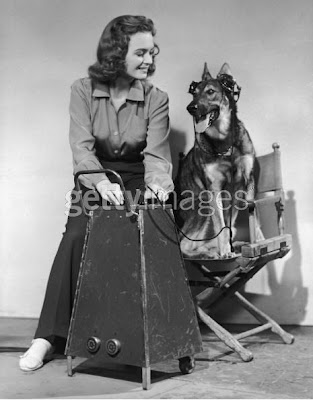
 And speaking of talent, that brings us to the cast. Edward Arnold steps away from his busy character acting status in such films as THREE ON A MATCH, WHISTLING IN THE DARK, THE GLASS KEY, YOU CAN'T TAKE IT WITH YOU, MR. SMITH GOES TO WASHINGTON, MEET JOHN DOE, and THE DEVIL AND DANIEL WEBSTER in order to play the lead here as blind detective Duncan "Mac" Maclain. Arnold is excellent in the role making a blind detective who can take on murderers and spies seem perfectly plausible. He is ably abetted by Friday the German Shephard who is an excellent trained actor performing lots and lots of terrific stunts as well as being a pretty good little actor himself.
  Ann Harding will forever be known to me from her terrified leading lady status opposite a scene-chewing Basil Rathbone in the classic thirties thriller LOVE FROM A STRANGER. A very young Donna Reed plays her "Veda"-like role as the petulant daughter nicely as well; proving she had acting chops even this early in her career. Reed, of course, would win the Oscar for FROM HERE TO ETERNITY (once more teaming with director Zinnemann) as well as memorable roles in THE PICTURE OF DORIAN GRAY and IT'S A WONDERFUL LIFE.
  Silent film veteran Reginald Denny was around for a long time in films ranging from Buster Keaton's PARLOR, BEDROOM AND BATH, PRIVATE LIVES (1931), THE LOST PATROL, ROMEO AND JULIET (1936), a slew of BULLDOG DRUMMOND films as sidekick Algy, Alfred Hitchcock's REBECCA, MR. BLANDINGS BUILDS HIS DREAM HOUSE, CAT BALLOU and all the way to his final film: BATMAN based on the campy 60's TV series. Caddish Paul Gerente is played by terminal cad John Emery who played similarly-flavoured roles in such films as HERE COMES MR. JORDAN, Hitchcock's SPELLBOUND, ROCKETSHIP X-M, THE MAD MAGICIAN, Jayne Mansfield starrer THE GIRL CAN'T HELP IT, KRONOS and the BORIS KARLOFF'S THRILLER episode "The Devil's Ticket" as the Devil himself. Type casting. Longtime character actress Rosemary DeCamp appears here as a compromised maid in with the Nazis; among her countless roles on television and in films are YANKEE DOODLE DANDY (playing much older than her actual age as was her wont) as James Cagney's mother, STRATEGIC AIR COMMAND with James Stewart, William Castle's scare-fest 13 GHOSTS as well as recurring roles on TV's THE LIFE OF RILEY (as Peg), THE BOB CUMMING SHOW and THAT GIRL (as Marlo Thomas' mother Mrs. Marie).
  Stage actress Katherine Emery is nicely sinister as the Nazi bund leader. This was her first film role and her small list of movies includes Val Lewton's chiller ISLE OF THE DEAD with Boris Karloff, and her final film THE MAZE. And I'm sorry but nobody can convince me that Katherine Emery is not the long-lost sister of Mercedes McCambridge; the resemblance is uncanny and the voice is almost exactly the same if only lower! Another Nazi is played by Stanley Ridges who is probably most familiar to horror fans for his showing role in the forgettable borefest BLACK FRIDAY alongside wasted Boris Karloff and Bela Lugosi; other films includes roles in UNION PACIFIC, EACH DAWN I DIE, MR. DISTRICT ATTORNEY, SERGEANT YORK, TO BE OR NOT TO BE, WILSON, POSSESSED and THE FILE ON THELMA JORDAN. Finally we have a small role by the beloved comedian
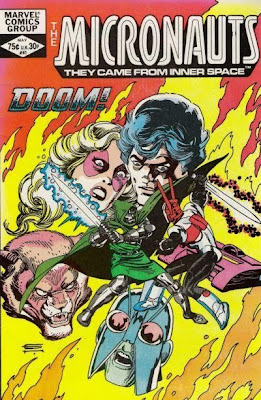
  Yes, true believers, next week over there on the right the Comic Cover of the Day will be featuring Dr. Doom fighting on the covers of many different Marvel Mags causing major headaches for practically the entire Marvel stable of heroes. So get ready when the mayhem begins this Sunday!